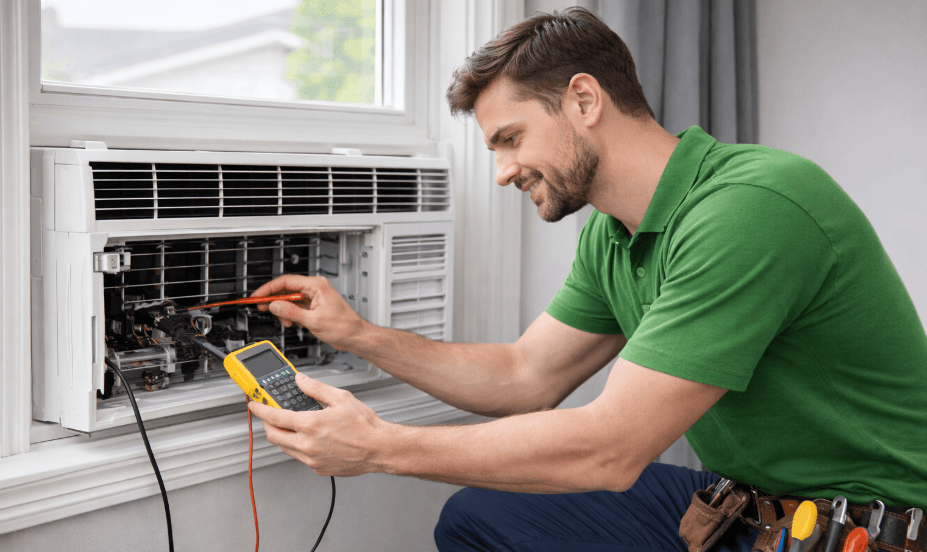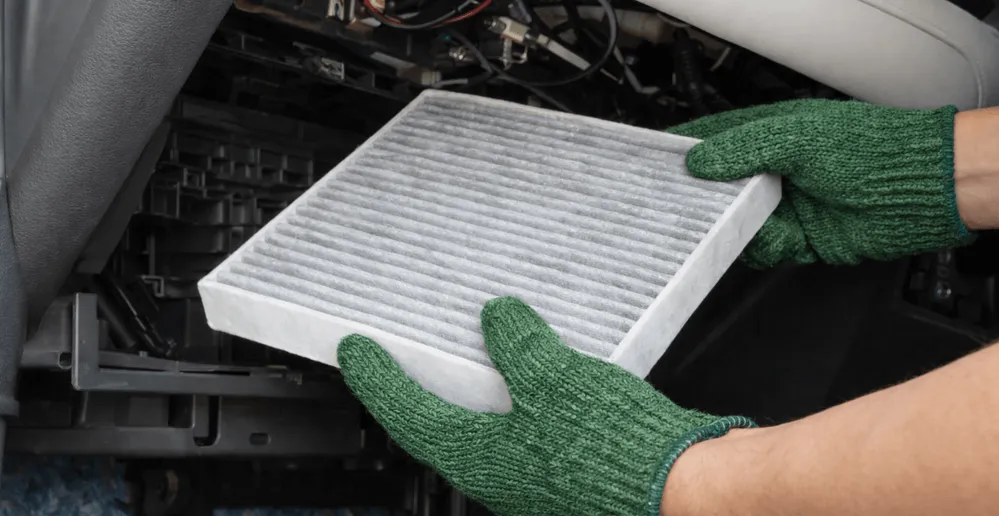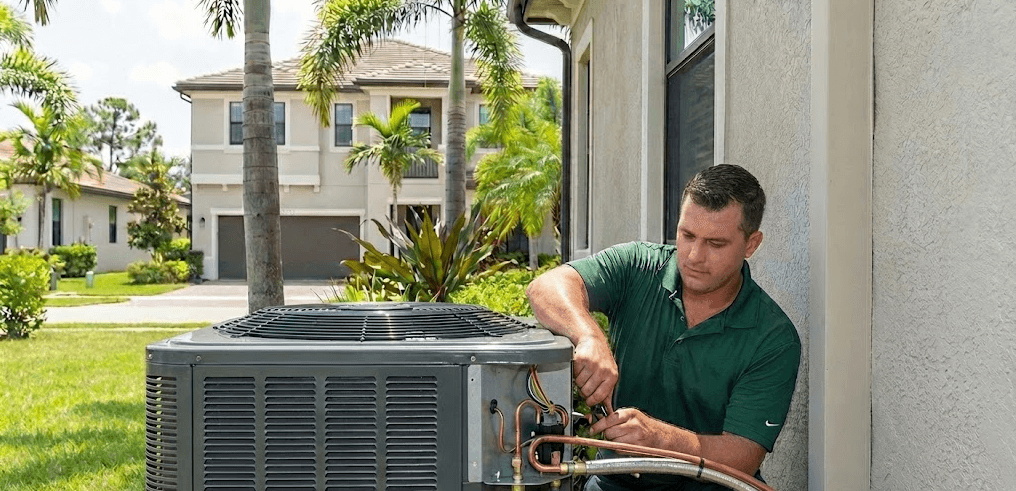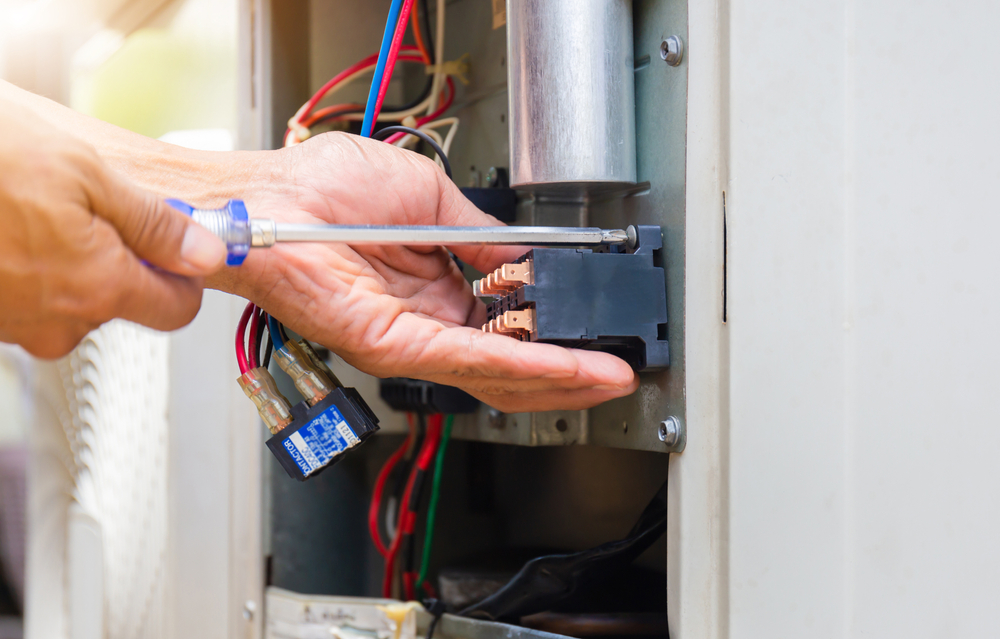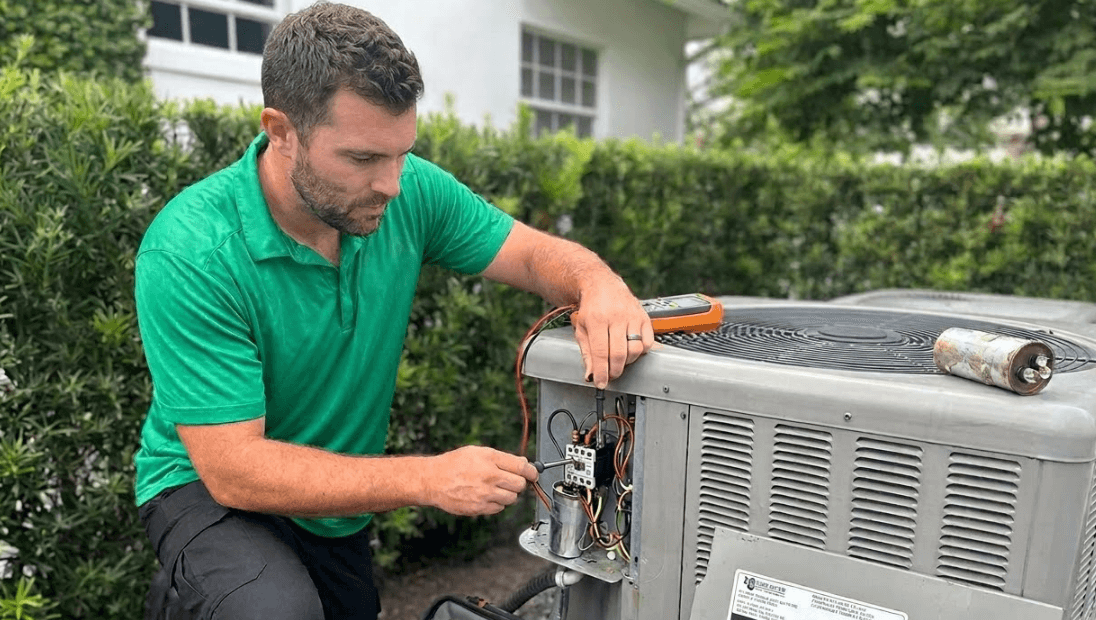
When your AC is out, the last thing you want to do is gamble on a repair company that you know nothing about. We get it – because at Filterbuy HVAC Solutions, we’re in the homes of our clients every day, solving the exact kind of problems you are dealing with right now. From units that blow warm air to those that won’t stop short-cycling, we have seen it all, and we have learned that the reason between a good repair experience and a nightmare is usually revolved around three things – speed, transparency, and technical know-how.
We built this guide based on the things we have seen firsthand working with homeowners around the country – Not some recycling advice that has been recycled from the internet. You’ll get the help to understand how you can find a trustworthy and best local AC repair company, along with the possible questions that you can ask when anyone touches your system, and how to avoid all those mistakes that will cost you a lot, but make it a big headache. Your home is simply too important, and the comfort and quality of air contained in it is too vital to leaving it to chance, so let’s get this right the first time.
TL;DR Quick Answers
Local Air Conditioner Repair
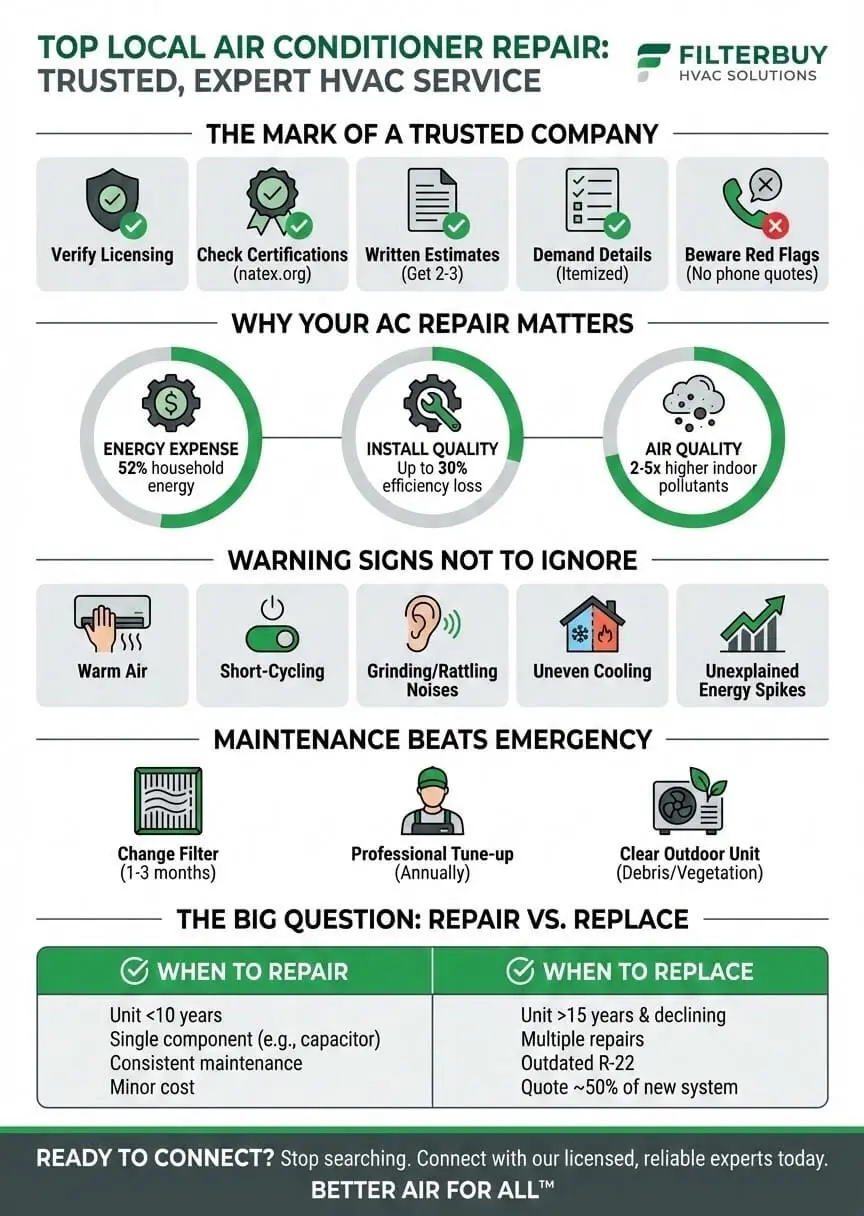
Finding a trustworthy local air conditioner repair company comes down to three things we see matter most in the field: speed, transparency, and verified credentials.
Here’s what to do right now:
- Check that the company is licensed and insured in your state
- Verify technician certifications at natex.org
- Get 2–3 written estimates before committing
- Ask for an itemized breakdown of parts, labor, and warranty terms
Red flags to avoid:
- Quoting a price over the phone without inspecting your system
- Pressuring you into immediate decisions
- Refusing to put the estimate in writing
What we tell every homeowner at Filterbuy HVAC Solutions: The best local AC repair company isn’t the cheapest or the closest — it’s the one that shows up on time, explains the problem in plain language, and stands behind their work. Do 20 minutes of homework before you call, and you’ll save yourself hours of headaches later.
Top 5 Takeaways
- Your AC is your biggest energy expense. Heating and cooling use over 52% of household energy. A struggling system costs you more every month.
- Who does the work matters. Bad installs cut efficiency by up to 30%. Verify licensing, insurance, and NATE certification first.
- Your AC controls your air quality. Indoor pollutants run 2–5x higher than outdoor levels. A neglected system recirculates what your family breathes.
- Maintenance beats emergency repair. Change filters every 1–3 months. Schedule an annual tune-up. These two habits prevent most breakdowns.
- Knowledge is your best protection. Get multiple estimates. Demand itemized pricing. Check credentials. Never hire a company that can’t explain the problem clearly.
What Makes a Top-Rated Local AC Repair Company Stand Out
Not all HVAC companies work the same way and from our experience servicing houses throughout the country, the best ones have a few common traits: They appear when they say they will, will explain the problem in basic English before they do any work and give you an honest estimate-not a lowball number to get you from the time they get there to the time they are done with the job. A top-rated local AC repair company did not get its reputation for service by having flashy advertising, but through consistent service and full payment.
Signs Your Air Conditioner Needs Professional Repair
Most AC problems don’t occur overnight – they add up. If you are seeing that your system is blowing on warm or cold air, turning on and off every few minutes, making grinding or rattling noises, or some rooms in your house being warmer than other rooms, these are all signs that something definitely needs to be taken care of. We’ve also seen enough homeowners overlook a spike in their energy bill, whereas they really have no idea that their AC is working double hard due to a failure in one of its components. Catching these things early almost always translates to a simpler fix – and an affordable one.
How to Choose the Right HVAC Service Provider Near You
When you’re looking around for “AC repair near me,” it’s very easy to just click the first option and hope for the best. Try looking for more. Look for companies that are licensed and insured by your state, have front-end pricing with no surprises, and have a warranty for their work. Check out some recent customer reviews (try not to just look at the star ratings, but what people have to say about communication, punctuality, and follow-through.
Common AC Repairs and What They Typically Cost
Understanding the basics of common repairs helps you have a smarter conversation with your technician. Refrigerant recharges, capacitor replacements, fan motor repairs, and thermostat issues are among the most frequent fixes we see. Costs can vary depending on your system type, the age of your unit, and your location, but a trustworthy company will always walk you through what’s needed and why before any work begins. If someone can’t clearly explain the repair, that’s a red flag worth paying attention to.
“After years of working in homes across the country, we’ve learned that the AC companies homeowners trust most aren’t the ones with the biggest ads—they’re the ones who show up on time, explain the problem honestly, and never push a repair you don’t actually need. That’s the standard we hold ourselves to at Filterbuy HVAC Solutions, and it’s what we encourage every homeowner to demand from any company they let into their home.” — Filterbuy HVAC Solutions Team
7 Must-Have Resources Before You Hire a Local AC Repair Company
These are the same resources we’d point a friend toward—because when it comes to your home, your comfort, and your budget, you deserve to make the call with confidence.
1. Skip the Guesswork: Use ENERGY STAR’s Contractor Hiring Checklist
The EPA’s ENERGY STAR program lays out a simple, no-nonsense checklist that covers everything from getting referrals to making sure your contractor actually evaluates your home before quoting a price. We recommend this one to customers all the time because it sets the right expectations from the start.
Source: ENERGY STAR — 10 Tips for Hiring a Heating and Cooling Contractor
URL: energystar.gov/saveathome/heating-cooling/10-tips-hiring
Why it matters: Helps you avoid the most common hiring mistakes and know what a quality estimate visit should look like.
2. Make Sure Your Technician Actually Knows Their Stuff — Verify NATE Certification
NATE is the industry’s top credential for HVAC technicians, and their free verification tool lets you confirm a technician’s qualifications in seconds. At Filterbuy HVAC Solutions, we think this should be a non-negotiable step before anyone opens up your unit.
Source: NATE — Verify a NATE ID
URL: natex.org/contractor/verify-a-nate-id
Why it matters: Confirms the technician servicing your system has passed rigorous, industry-recognized competency testing.
3. Know Your System Before the Technician Arrives — DOE’s Home Cooling Guide
The U.S. Department of Energy’s home cooling resource covers how central air operates, when to change filters, and simple steps to keep your energy bills in check. We’ve found that homeowners who understand their systems are far less likely to get talked into repairs they don’t need.
Source: U.S. Department of Energy — Home Cooling Systems
URL: energy.gov/energysaver/home-cooling-systems
Why it matters: Gives you a working knowledge of your AC system so you can have smarter conversations with any technician.
4. Protect Yourself From Contractor Scams With the FTC’s Consumer Guide
The Federal Trade Commission’s contractor guide helps you spot the warning signs of a scam—like pressure for immediate decisions, requests for full payment upfront, or contractors who won’t put things in writing. The FTC advises homeowners to only consider contractors who are licensed and insured, and to check with their state or county government to confirm a contractor’s license. We wish every homeowner would read this before picking up the phone.
Source: Federal Trade Commission — How to Avoid a Home Improvement Scam
URL: consumer.ftc.gov/articles/how-avoid-home-improvement-scam
Why it matters: Federal consumer protection guidance that helps you identify red flags and protect your money before signing anything.
5. Decode SEER Ratings and Efficiency Standards — DOE’s Air Conditioning Resource
The Department of Energy’s air conditioning page breaks down efficiency ratings, how modern AC systems work, and what the latest federal standards mean for your home. This is especially useful if you’re weighing whether to repair your current unit or invest in a more efficient replacement.
Source: U.S. Department of Energy — Air Conditioning
URL: energy.gov/energysaver/air-conditioning
Why it matters: Helps you understand the efficiency metrics that directly impact your energy bills and long-term repair vs. replace decisions.
6. Understand What New Efficiency Rules Mean for Your Wallet — EIA’s Standards Guide
The updated standards require a minimum of 14 SEER for systems in the northern U.S. and 15 SEER in southern regions where cooling loads represent a larger share of home energy use. If your unit is more than 10 years old, this resource from the U.S. Energy Information Administration helps you understand how today’s standards compare—and what upgrading could save you.
Source: U.S. Energy Information Administration — Efficiency Requirements for Residential Central AC and Heat Pumps
URL: eia.gov/todayinenergy/detail.php?id=40232
Why it matters: Gives you the federal context to evaluate whether your aging system still meets current efficiency benchmarks.
7. Understand Why Your AC Repair Impacts the Air You Breathe — EPA’s Indoor Air Quality Guide
The EPA’s indoor air quality resource explains how your HVAC system directly affects the air circulating through your home, including how pollutants like mold, dust, and allergens build up when systems aren’t properly maintained or repaired.
Source: U.S. Environmental Protection Agency — Indoor Air Quality
URL: epa.gov/indoor-air-quality-iaq
Why it matters: Connects your AC system’s performance to the quality of air your family breathes every day—and shows why timely repairs and proper filtration aren’t just about comfort.
Supporting Statistics: What the Numbers Tell Us — And What We’ve Seen Firsthand
Here’s what the research says, paired with what we’ve learned working in homes across the country.
1. Your AC is the biggest line item on your energy bill.
The U.S. Energy Information Administration found that over half of a household’s annual energy consumption — 52% in 2020 — goes to just two end uses: space heating and air conditioning.
We see the real impact of that number all the time. When a system hasn’t been serviced in years, we already know what the homeowner is going to say: “Our bills keep going up, but we haven’t changed anything.”
Source: U.S. Energy Information Administration (EIA) — Use of Energy in Homes
URL: eia.gov/energyexplained/use-of-energy/homes.php
2. The air inside your home is likely dirtier than the air outside.
According to the EPA, Americans spend roughly 90% of their time indoors, where concentrations of some pollutants are often 2 to 5 times higher than typical outdoor concentrations.
That surprises a lot of homeowners we talk to. They assume closed windows mean cleaner air. But we’ve pulled filters out of systems that haven’t been changed in over a year — filters so packed with debris that almost nothing was getting through.
When that happens, your system isn’t filtering. It’s just recirculating whatever’s floating around your house.
Source: U.S. Environmental Protection Agency (EPA) — Indoor Air Quality
URL: epa.gov/report-environment/indoor-air-quality
3. A bad repair or installation can waste nearly a third of your system’s efficiency.
ENERGY STAR reports that improper installation can reduce system efficiency by up to 30%, costing homeowners more on utility bills and potentially shortening the equipment’s life.
This one hits closest to home for our team — because we’ve been called out to fix work that another company did wrong.
Source: ENERGY STAR — Heat & Cool Efficiently
URL: energystar.gov/saveathome/heating-cooling
Final Thought: Why the Right AC Repair Company Changes Everything
If there’s one thing we’d want you to take away from this page, it’s this: don’t just search for the cheapest option or the first name that pops up.
Look for a company that:
- Shows up on time and respects your schedule
- Explains the problem in plain language before doing any work
- Provides an honest, written estimate with no hidden fees
- Holds proper licensing, insurance, and technician certifications
- Backs their work with a clear, enforceable warranty
Those aren’t extras. Those are the bare minimum of what you deserve.
Your home is where your family sleeps, eats, and breathes. The system controlling the air in every room isn’t something to gamble on — and the company you trust to keep it running shouldn’t be either.
We’re biased, of course. We believe better air starts with better service, and we’ve built Filterbuy HVAC Solutions around that idea from day one. But whether you call us or someone else:
- Do your homework
- Check credentials
- Ask the hard questions
- Use the resources we’ve listed above
- Never settle for a company that can’t clearly explain what they’re doing and why
Your comfort, your air quality, and your budget are all connected to the same system. Protect it as it matters — because it does.
Next Steps: Take Action to Protect Your Home’s Comfort and Air Quality
You’ve done the research. Now it’s time to put it to work. Here are five actionable steps we recommend based on what we’ve seen work best for homeowners across the country.
1. Assess your current system.
Take five minutes to check on the basics before calling anyone:
- System age: Over 10 years? Get a professional evaluation.
- Air filter: Can’t remember the last change? It’s overdue.
- Warning signs: Warm air, strange noises, short-cycling, or uneven cooling between rooms.
- Energy bills: Unexplained increases often point to a system struggling to keep up.
Write down what you’re experiencing. It gives any technician a head start on diagnosing the issue.
2. Verify before you call.
Don’t pick a company on name recognition alone.
- Confirm they’re licensed and insured in your state
- Look up technician certifications through NATE’s verification tool
- Read recent reviews — focus on communication, punctuality, and follow-through
- Check for complaints through your state’s contractor licensing board
3. Get multiple estimates — and compare the right things.
We recommend at least two to three written estimates. When comparing, look beyond the bottom line:
- Is the estimate clearly itemized — parts, labor, and warranty terms?
- Did the technician inspect your system in person before quoting?
- Are they explaining what needs to be done and why?
- Is the warranty covering both parts and labor?
The lowest price isn’t always the best deal. The best deal is honest, thorough, and backed by accountability.
4. Schedule routine maintenance — don’t wait for a breakdown.
The best AC repair is the one you never need.
- Change your air filter every 1 to 3 months.
- Schedule a professional tune-up at least once a year — ideally before peak cooling season.
- Keep your outdoor unit clear of debris and vegetation
- Consider a maintenance plan if your HVAC company offers one
5. Take charge of your home’s air quality.
Your AC system does more than cool your home — it filters the air your family breathes every day.
- Upgrade to a higher-efficiency filter if your system supports it
- Find your exact filter size at Filterbuy — shipped fast, free, and factory-direct
- Set up auto-delivery so you never miss a filter change
- Need professional service? Connect with Filterbuy HVAC Solutions for expert help you can trust
Frequently Asked Questions
Q: How do I find a reliable local air conditioner repair company near me?
A: Slow down for 20 minutes before you commit — it’ll save you hours of frustration later. Start with a referral from someone who’s had work done recently, then verify before you schedule.
What we recommend checking first:
- Valid license and insurance in your state
- Technician certifications through NATE’s verification tool
- Recent customer reviews — look for patterns in communication, punctuality, and problem resolution
- Written estimates from at least two to three companies
Q: How much does a typical local AC repair cost?
A: Most common residential HVAC repairs fall between $150 and $600, based on what we see across our service calls. But the honest answer is: be skeptical of any company that quotes a price over the phone without seeing your system first.
Lower end ($150–$300):
- Capacitor replacement
- Refrigerant recharge
- Thermostat repair
Higher end ($400–$600+):
- Compressor repair
- Evaporator coil replacement
- Blower motor replacement
What matters more than the number:
- Did the technician diagnose the problem in person before quoting?
- Is the estimate itemized — parts, labor, and warranty terms broken out clearly?
- Does the price
Q: What are the most common signs my air conditioner needs professional repair?
A: After years of walking into homes mid-breakdown, we can usually tell within the first few minutes what’s happening — because the warning signs are almost always the same. The problem is that most homeowners don’t recognize them until the system stops entirely.
Call a professional if you notice:
- Warm air from vents — the most common trigger for calls, but usually means the problem has been building
- Short-cycling — the system kicks on and off every few minutes without completing a full cooling cycle
- Strange noises — grinding signals mechanical failure, rattling means something’s loose, buzzing points to electrical issues
- Uneven cooling — one room comfortable, the next feels like a different house.
- Rising energy bills — we’ve seen bills double in two months without the homeowner knowing their AC was the cause.
- Visible moisture or ice around the indoor unit — never normal
Q: How often should I schedule maintenance on my air conditioning system?
A: Once a year at minimum. Book it in the spring before the summer rush — by June, wait times stretch, emergency rates go up, and your options shrink.
Between professional visits, handle these yourself:
- Change your air filter every 1 to 3 months. This is the single most impactful thing you can do. Find your exact size at Filterbuy and set up auto-delivery so it’s one less thing to remember.
- Clear your outdoor unit. Trim vegetation and remove leaves or debris blocking airflow.
- Keep indoor vents and return grilles open. Closing vents doesn’t save energy — it creates pressure problems that damage the system.
- Listen to your system. If something sounds or feels different, don’t wait to address it.
Q: When should I repair my AC versus replacing it entirely?
A: This is the question we spend the most time on with homeowners — and the toughest to answer without seeing the system. Consider the following:
Lean toward replacement when:
- The unit is over 15 years old and declining
- You’ve needed two or three repairs in the last couple of years — that’s a pattern
- System runs on R-22 refrigerant (phased out, now extremely expensive)
- The repair quote is approaching 50% of the cost of a new system
Lean toward repair when:
- Unit is under 10 years old and otherwise healthy
- The issue is isolated to a single failed component
- You’ve been consistent with annual maintenance and filter changes
Ready to Find a Top Local Air Conditioner Repair Company You Can Trust?
Stop searching and start taking action — use the resources, checklist, and expert guidance above to connect with a licensed, reliable HVAC service provider near you today. And when it’s time to protect your system between service calls, Filterbuy has you covered with the right air filters shipped fast, free, and factory-direct to your door.