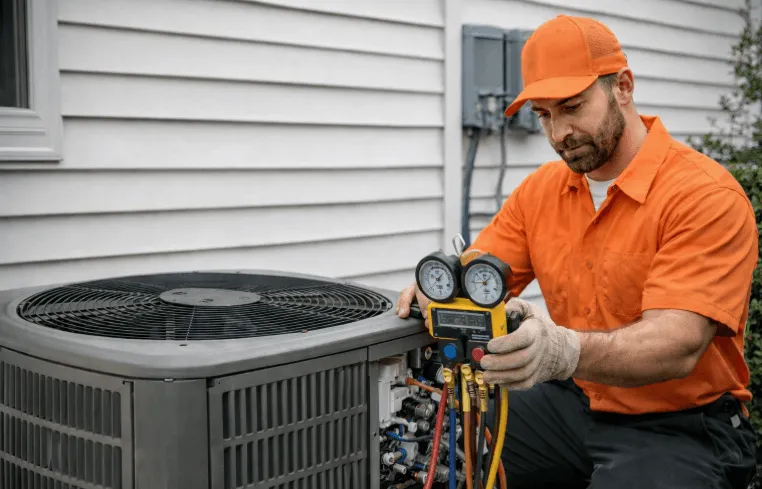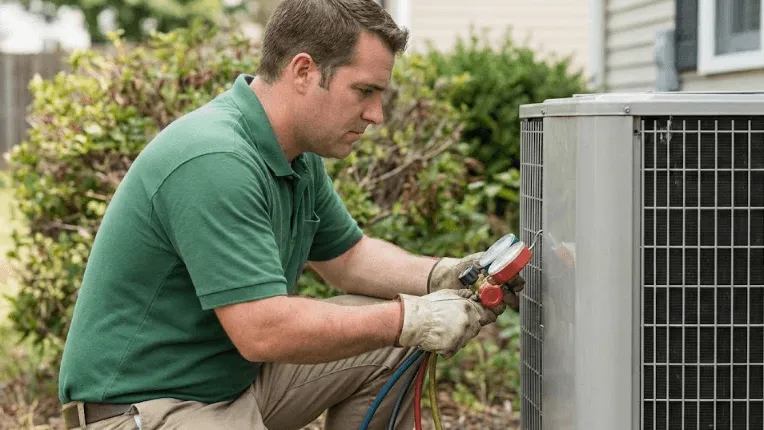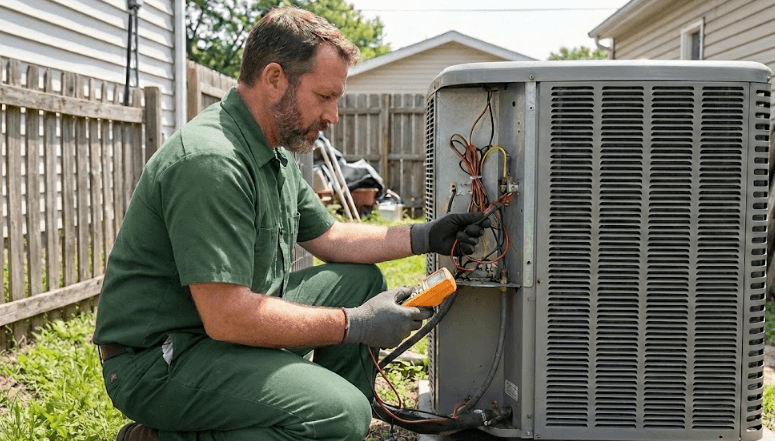


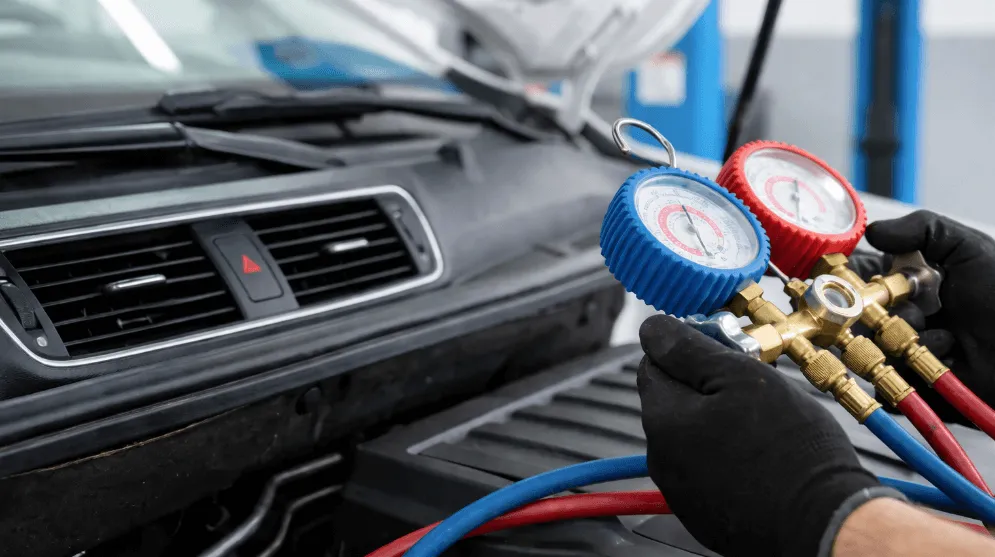
As your neighbors who happen to be HVAC professionals, we know firsthand that a neglected AC system and a car blowing warm air in July are two problems no one wants to deal with at the same time. After years of servicing homes right here in your community, we’ve seen what happens when seasonal tune-ups get pushed to the back burner — higher energy bills, unexpected breakdowns, and uncomfortable families during the worst heat of the year. This page brings together trusted local AC tune-up services and nearby auto cooling deals so you can tackle both in one stop. From our experience maintaining systems in homes just like yours, we’ll share what a quality tune-up actually includes, which seasonal offers deliver real value, and how to keep your home and vehicle running cool all season long without overpaying.
TL;DR Quick Answers
The best way to save on AC tune-ups and car cooling deals this season is to act before peak summer demand, when providers offer their deepest discounts, and scheduling is wide open.
For your home AC tune-up:
- Book in early spring — March or April is ideal
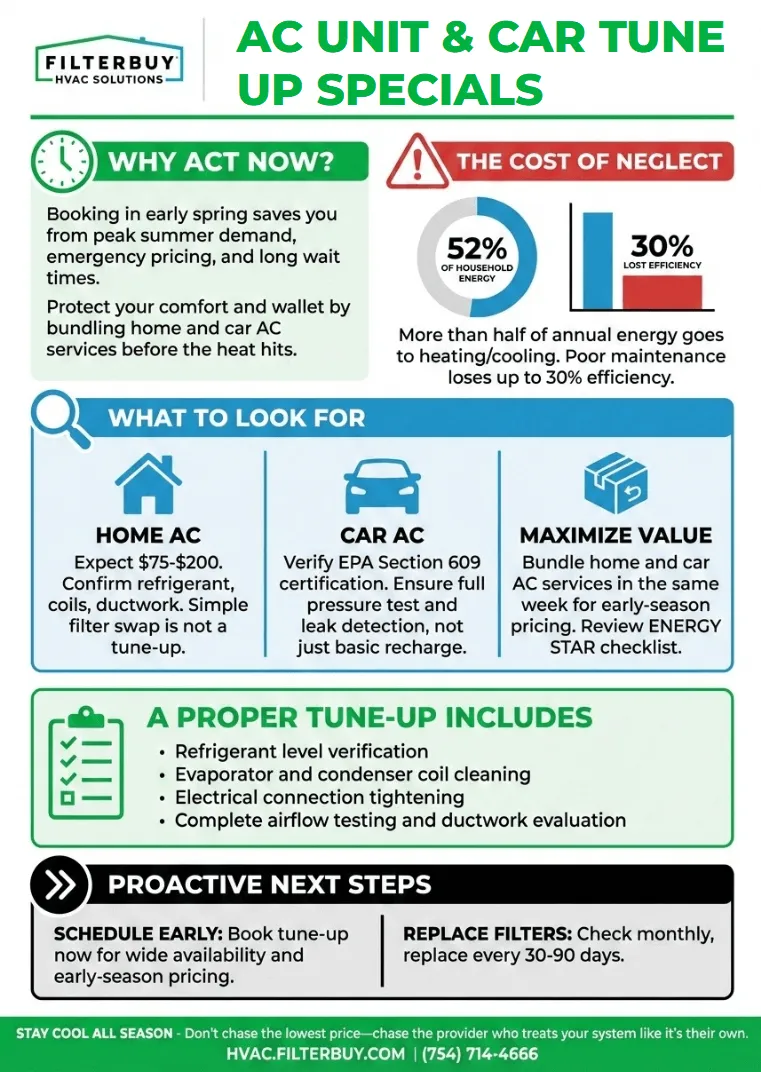
- Expect to pay $75 to $200 for a legitimate full-system inspection
- Confirm the service covers refrigerant, coils, airflow, ductwork, and electrical connections
- A filter swap alone is not a tune-up
For car AC specials near you:
- Ask if leak detection is included before any refrigerant is added
- Verify the shop holds EPA Section 609 certification
- Make sure the service includes a full system pressure test — not just a basic recharge
- Average professional car AC recharge costs range from $250 to $350
How to get the most value this season:
- Bundle your home and car AC services in the same week to maximize early-season pricing
- Review ENERGY STAR’s maintenance checklist to know what a proper tune-up includes
- Check the FTC’s auto repair consumer guide to understand your rights before committing
- Set recurring calendar reminders for spring and fall maintenance so you never fall behind
From our experience as your neighbors who happen to be HVAC professionals, the families who schedule early, ask the right questions, and choose providers based on thoroughness over price are the ones who stay cool all summer without the stress, the emergency pricing, or the mid-season breakdown.
Top Takeaways
- Your AC is your biggest energy expense. Heating and cooling account for over 52% of household energy consumption. A seasonal tune-up is the most impactful step you can take to lower monthly costs before summer.
- Not all tune-up deals are equal. Always confirm your provider will inspect refrigerant levels, coils, ductwork, and electrical connections. If it’s just a filter swap, it’s not a real tune-up.
- Skipping maintenance costs more than you think. Neglected systems lose up to 30% efficiency. That means higher bills, shorter equipment life, and emergency repairs at the worst possible time — for both your home AC and your car.
- Scrutinize car AC specials before committing. Verify the shop is EPA-certified. Ask if they test for leaks before adding refrigerant. Make sure the service goes beyond a basic recharge.
- Act before the heat forces your hand. Homeowners who schedule early consistently avoid:
- Premium emergency pricing
- Longer wait times during peak demand
- The stress of a mid-summer breakdown
- Costly repairs that proper maintenance would have prevented
What a Proper AC Unit Tune-Up Actually Includes
As far as we have been working on the service of the homes all over the community, we have come to know that not every tune-up is the same. A good AC tune-up ought to include checks on the level of refrigerant, coil cleaning, inspection of electrical connections, checking of thermostats, and testing of the airflow in your ductwork. These are not merely items on a list of things in an invoice; each one has a direct effect on the efficiency of your system and the amount of money you spend on your energy bills at the end of each month.
Why Seasonal AC Deals Are Worth Acting On Now
Time is everything, as people are aware. The automobile service center and HVAC companies usually give the best deals in the first weeks of the cooling season when they are filling their schedules. Waiting till the high season implies greater demand, more waiting, and fewer deals to make. According to what we witnessed over the past few years in this market, customers who book their tune-ups in advance will save more and will not have to face the stress of making an emergency call when temperatures suddenly shoot high.
Car AC Service: What to Look for in a Local Auto Deal
Your vehicle’s air conditioning system needs attention, too, especially after sitting through cooler months without heavy use. A solid car AC service should include a refrigerant recharge, compressor inspection, cabin filter replacement, and a full system pressure test. When evaluating local auto specials, look beyond the advertised price and ask what’s actually included. The best deals bundle multiple services together rather than charging separately for each component.
How to Compare Local Tune-Up Offers Near You
Not every deal that looks good on the surface delivers real value. Here’s what we recommend based on years of working with local homeowners. Check whether the offer includes a full-system inspection or just a basic air filter swap. Ask if the technician will test airflow and check for duct leaks. Read recent customer reviews to confirm the provider actually follows through on what they advertise. A slightly higher price from a trusted local team almost always beats a rock-bottom offer from a provider cutting corners.
Keeping Your Home and Car Cool All Season Long
The best approach to staying comfortable this season is a proactive one. Schedule your home AC tune-up and car AC service before the heat arrives, take advantage of early-season specials while they last, and stay on top of basic maintenance like filter changes between professional visits. When you combine smart timing with quality service from providers who genuinely know your area, you protect your comfort, your equipment, and your wallet all at once.
“After years of maintaining AC systems in homes right here in this community, we’ve learned that the difference between a tune-up that actually lowers your energy bills and one that just checks a box comes down to the technician’s willingness to inspect what most providers skip — and that’s something we take personally as your neighbors.”
Essential Resources We Recommend to Help You Make Smarter AC Tune-Up and Car Cooling Decisions This Season
After years of servicing homes in this community, we’ve seen too many neighbors overpay for incomplete tune-ups or fall for car AC deals that don’t deliver what they promise. Before you book any service this season, these are the resources we personally recommend to help you walk in informed and confident — because we believe the more you know, the better decisions you’ll make for your family’s comfort.
1. Understand What Your Home AC Tune-Up Should Actually Include
We always tell our neighbors the same thing — if you don’t know what a proper tune-up looks like, it’s hard to tell if you’re getting one. The DOE breaks down the core maintenance tasks every homeowner should expect, from filter replacement schedules to coil cleaning and condensate drain care. We recommend reviewing this before any technician shows up at your door, so you know exactly what to look for.
U.S. Department of Energy — Air Conditioner Maintenance
https://www.energy.gov/energysaver/maintaining-your-air-conditioner
2. Verify Your HVAC Contractor Is Performing a Complete Inspection
In our experience, the difference between a tune-up that protects your system and one that just checks a box comes down to how thorough the inspection really is. ENERGY STAR’s official checklist details everything a qualified contractor should be checking, from refrigerant levels and blower adjustments to electrical connections and system controls. We use this as our own standard — and we think you should hold any provider to it.
ENERGY STAR — HVAC Maintenance Checklist
https://www.energystar.gov/saveathome/heating-cooling/maintenance-checklist
3. Lower Your Cooling Bills Before and After Your Tune-Up
Here’s something we share with our neighbors all the time — a professional tune-up is only part of the equation. The DOE’s seasonal guide covers practical steps you can take on your own, like thermostat programming, weatherstripping, and ventilation improvements, that work hand-in-hand with professional maintenance to keep your energy bills as low as possible all summer.
U.S. Department of Energy — Spring and Summer Energy-Saving Tips
https://www.energy.gov/energysaver/spring-and-summer-energy-saving-tips
4. Confirm Your Car AC Technician Meets Federal Certification Requirements
We may be HVAC professionals first, but as your neighbors, we want you protected across the board. The EPA outlines exactly what certifications and procedures any paid auto AC technician must follow under the Clean Air Act, including approved refrigerant types and proper handling requirements. Before you jump on any car AC deal, use this resource to make sure the shop is operating the way it should.
EPA — Regulatory Requirements for Motor Vehicle AC System Servicing
https://www.epa.gov/mvac/regulatory-requirements-mvac-system-servicing
5. Know the Rules Governing Your Home HVAC Refrigerant Handling
Refrigerant handling isn’t something to take lightly — we’ve seen what happens when it’s done wrong, and it’s not pretty for your system or your wallet. Section 608 of the Clean Air Act sets strict rules for how technicians recover, recycle, and dispose of refrigerants in residential HVAC systems. Understanding these basics helps you feel confident that whoever services your home is following the proper safety and environmental protocols.
EPA — Managing Refrigerant in Stationary Refrigeration and Air Conditioning Equipment
https://www.epa.gov/section608
6. Protect Yourself From Auto Repair Overcharges and Warranty Issues
We genuinely care about our neighbors getting a fair deal, whether it’s on home comfort or vehicle maintenance. The FTC’s consumer guide walks you through your rights when it comes to auto repair warranties, how to evaluate a mechanic before saying yes to any work, and the steps to take if something goes wrong. We always recommend reviewing this before committing to any seasonal car AC special.
FTC Consumer Advice — Auto Repair Basics
https://consumer.ftc.gov/articles/0211-auto-repair-basics
7. Understand What a Car AC Recharge Costs and What It Involves
Just like we’d give you an honest breakdown of what your home AC service should cost, KBB does the same for your vehicle’s cooling system. Their consumer-friendly guide covers average professional and DIY cost ranges, explains the recharge process step by step, and helps you recognize when a simple top-off won’t solve the real problem. It’s a smart read before you evaluate any auto AC deal this season.
Kelley Blue Book — AC Recharge: What Is It?
https://www.kbb.com/car-advice/ac-recharge-what-is-it/
Supporting Statistics That Confirm What We’ve Been Telling Our Neighbors for Years
When we share maintenance advice with homeowners in this community, it’s backed by what we’ve personally witnessed on thousands of service calls and supported by data from the agencies that track these numbers nationally.
1. Over Half Your Energy Bill Is Riding on How Well Your AC Performs
The U.S. Energy Information Administration’s 2020 Residential Energy Consumption Survey found that more than 52% of a household’s annual energy consumption goes toward space heating and air conditioning alone.
From our experience servicing homes in this area, that number feels conservative for our climate. We’ve sat with neighbors who couldn’t figure out why their bills kept climbing — and more often than not, the answer was an AC system that hadn’t been properly serviced in years.
What this means for you:
- Your AC is the single biggest energy draw in your home
- A neglected system costs you more every month without you realizing it
- A seasonal tune-up is the most practical investment you can make before summer hits
Source: https://www.eia.gov/energyexplained/use-of-energy/homes.php
2. Neglected Maintenance Can Cost You Up to 30% of Your System’s Efficiency
According to ENERGY STAR, poorly maintained HVAC equipment can lose up to 30% of its efficiency, and sealing ductwork alone can recover up to 20% of that lost performance.
We’ve seen this firsthand more times than we can count. Just last season, we serviced a four-year-old system running like it was on its last legs — not because the equipment was bad, but because no one had touched it since installation day.
What we check on every tune-up to prevent this:
- Refrigerant levels to ensure proper cooling output
- Coil condition and cleanliness for maximum heat transfer
- Airflow testing and ductwork inspection for hidden leaks
- Electrical connections and system controls for safe operation
Source: https://www.energystar.gov/saveathome/heating-cooling
3. Nearly 9 Out of 10 U.S. Homes Depend on AC — Around Here, It’s Practically All of Them
The U.S. Energy Information Administration reports that 88% of American households now use air conditioning, with AC accounting for roughly 19% of all residential electricity consumption.
Living and working in this community ourselves, we know that number is even higher in our area. Every summer, we get emergency calls from neighbors whose systems gave out on the hottest day of the year — and the story is almost always the same: the tune-up got pushed off one season too many.
Why scheduling early matters:
- Homes tuned up before peak demand run more efficiently all season
- Early scheduling avoids premium emergency pricing and long wait times
- Proactive maintenance prevents the panic of a mid-summer breakdown
- Systems serviced annually last longer and cost less to operate overall
Source: https://www.eia.gov/todayinenergy/detail.php?id=52558
Final Thought: Why the Best Deal This Season Is the One You Don’t Have to Think About Twice
After years of maintaining HVAC systems in homes throughout this community, we’ve learned something no coupon or seasonal special can replace — peace of mind. The homeowners who stay comfortable all summer aren’t the ones who found the cheapest deal. They’re the ones who made the smart decision early and chose a provider they trust.
Most AC tune-up deals and car cooling specials look great on paper. But from what we’ve seen firsthand, the value of any deal comes down to three things:
- What’s actually included in the service
- Who’s performing the work and what credentials they hold
- Whether they genuinely care about your long-term comfort or just your one-time payment
We’ve seen both sides of this play out in our community too many times:
- Neighbors who thought they saved money on a bargain tune-up, only to call us weeks later when the system broke down because the provider skipped half the checklist
- Families who grabbed an auto AC special that sounded too good to pass up, only to discover the recharge didn’t hold because nobody checked for the underlying leak
Here’s our honest take as your neighbors who happen to be HVAC professionals — don’t chase the lowest price this season. Chase the provider who will treat your system the way they’d treat their own.
What that looks like in practice:
- They check the ductwork even when it’s hard to reach
- They tell you what they’d actually do if it were their family’s home
- They explain what they found and why it matters before charging you for anything
- They follow up because your comfort is personal to them, not just professional
Whether it’s your home AC or your car’s cooling system, the best investment isn’t the flashiest deal — it’s the one performed by people who take it personally when your family isn’t comfortable. That’s the standard we hold ourselves to every day in this community, and it’s the standard you deserve from anyone who earns your business this season.
Next Steps: What to Do Right Now to Stay Cool and Save Money This Season
You’ve got the knowledge — now put it to work. Here are the specific steps we recommend to every neighbor who wants to get the most out of their AC tune-up and car cooling service this season.
1. Schedule Your Home AC Tune-Up Before Peak Season Hits
Book now while availability is open and early-season pricing is still in play. Before you commit, confirm the provider will:
- Perform a full-system inspection — not just a filter swap
- Check refrigerant levels, coil condition, and electrical connections
- Test airflow and inspect ductwork for leaks
- Provide a written summary of findings and recommendations
2. Replace Your Air Filter Today
This is the simplest step you can take right now — and it makes an immediate difference.
- Check your filter once a month during the cooling season
- Replace every 30 to 90 days, depending on household conditions
- Homes with pets or allergies should lean toward monthly air filter replacement
- Ensure the filter fits securely with no gaps around the edges
3. Evaluate Car AC Specials Before Committing
Not every deal is worth your money. Ask these questions before you say yes:
- Does the service include a full system pressure test or just a refrigerant top-off?
- Will the technician check for leaks before adding refrigerant?
- Is the shop using EPA-approved refrigerant and certified equipment?
- What warranty or guarantee comes with the service?
4. Review the Essential Resources on This Page
Take 15 minutes to build your confidence before spending a dollar. Start with:
- U.S. Department of Energy — what a proper home AC tune-up should include
- ENERGY STAR contractor checklist — how to verify thorough service
- FTC auto repair consumer guide — your rights on car AC deals
5. Set a Recurring Maintenance Reminder
The best plan is the one you never have to remember on your own. Set calendar reminders now:
- Spring (March–April): AC tune-up before summer demand
- Monthly (May–September): Check and replace the air filter as needed
- Fall (September–October): Heating system inspection before winter
- Year-round: Monitor car AC performance and address changes early
Ready to Get Started?
Take action before the heat forces your hand. Whether you need a professional AC tune-up, a second opinion on your system, or honest advice from a neighbor who happens to be an HVAC expert — we’re here and ready to help.
Frequently Asked Questions
Q: How much does a typical AC unit tune-up cost, and what should be included?
A: A professional home AC tune-up typically runs between $75 and $200. But having worked on systems throughout this community for years, we can tell you that price alone never tells the full story.
We’ve been called into homes where a neighbor paid bottom dollar for a tune-up that turned out to be nothing more than a filter swap and a glance at the thermostat.
A legitimate tune-up should always cover:
-
- Refrigerant level verification
- Evaporator and condenser coil cleaning
- Electrical connection tightening and testing
- Thermostat calibration
- Thorough ductwork evaluation for leaks
If any provider skips those steps, what you’re paying for isn’t maintenance — it’s a false sense of security that will cost more when something fails.
Q: How often should I schedule an AC tune-up for my home and an AC service for my car?
A: Based on everything we’ve seen, maintaining systems in homes just like yours, here’s the schedule we recommend:
- Home AC: Once a year in the spring — ideally March or April, before local temperatures push systems to their limits
- Car AC: Annual inspection before summer, even though most manufacturers don’t set a specific recharge schedule
We’ve personally handled too many emergency calls in July from neighbors who skipped spring maintenance, thinking they’d get to it later. The pattern is always the same — those who stay ahead of the season never end up stuck in the heat waiting for a repair slot.
Q: How can I tell if a local AC tune-up deal or car cooling special is actually worth the money?
A: This is one of the most important questions we get from neighbors. Our answer is always the same — dig past the headline price and find out what you’re actually getting.
For home AC deals, confirm the service includes:
- A complete multi-point system inspection
- Coil cleaning and ductwork inspection
- Refrigerant and airflow testing
- A written summary of findings
For car AC specials, ask before you commit:
- Will the technician perform a leak detection test before adding refrigerant?
- Does the service include a full system pressure test?
- Is the shop EPA-certified with approved equipment?
We’ve walked into homes where the previous provider skipped the coil cleaning entirely and left the homeowner thinking everything was fine — until the system broke down three weeks later. A provider who earns your trust with thorough work will always save you more than a flashy coupon from someone cutting corners.
Q: Can I combine my home AC tune-up and car AC service to save time and money this season?
A: That’s exactly what we recommend every year — and the neighbors who follow through consistently spend less overall.
Why bundling early works:
- HVAC providers and auto shops offer their strongest incentives when filling spring calendars
- Seasonal deals dry up fast once summer demand kicks in
- Scheduling is more flexible before every household in the area is competing for appointments
- Knocking both out in the same week sets you up for the entire season without stress
We’ve watched this pattern repeat year after year in our community. The same week you get your home system inspected is the perfect time to drop your car off for an AC check. Handle both while deals are fresh and wait times are short.
Q: What are the warning signs that my home AC or car AC system needs immediate attention?
A: After years of responding to emergency calls in this community, we’ve learned to recognize the warning signs that homeowners often overlook until it’s too late.
Home AC warning signs:
- Warm air blowing from vents that should be cold
- Unusual buzzing, clicking, or grinding sounds
- Frequent short-cycling — system turning on and off rapidly
- Noticeable spike in energy bills without a change in usage
- Ice forming on the refrigerant lines or the indoor coil
Car AC warning signs:
- Air takes noticeably longer to cool down than it used to
- Greasy or filmy residue under the vehicle near the AC components
- Compressor clutch not engaging when the system is turned on
- Musty or chemical odors coming through the vents
In both cases, what we tell every neighbor is the same: the longer you wait, the more expensive the fix becomes. Some of the most costly repairs we’ve handled started as small issues that a basic inspection would have caught weeks earlier.
Don’t Miss Your Chance to Save on AC Tune-Ups and Local Auto Cooling Deals This Season — Schedule Now Before Peak Demand Drives Up Prices and Wait Times
Whether your home AC needs a professional tune-up or your car’s cooling system isn’t performing as it should, we’re here as your trusted local HVAC neighbors to help you stay comfortable and save more all season long. Contact us today for a free estimate and find out why families throughout this community trust us to keep their homes and vehicles running cool when it matters most.