

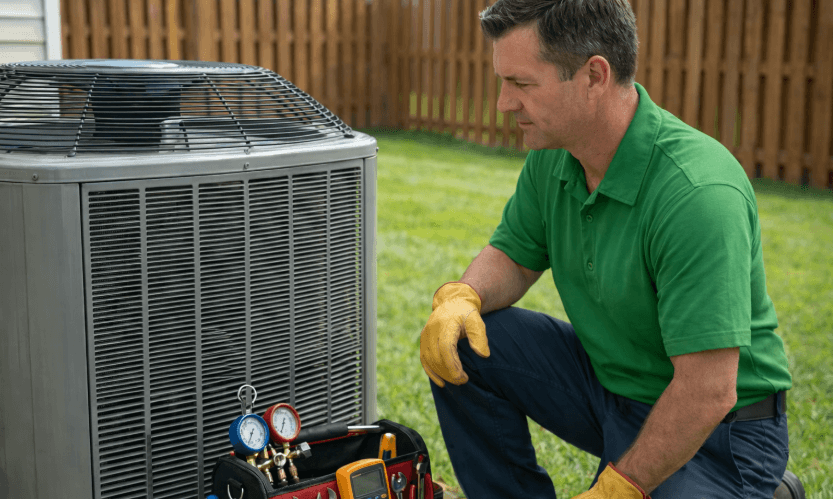
After servicing thousands of HVAC systems across the country, our Filterbuy HVAC Solutions technicians see the same thing over and over: homeowners paying for emergency repairs that a simple annual tune-up would have prevented. A clogged condensate drain here, a worn capacitor there—small issues that quietly snowball into costly breakdowns, higher energy bills, and uncomfortable homes.
This guide gives you the insider knowledge to protect your home’s three greatest assets: your family’s comfort, your HVAC system’s longevity, and the air you breathe every day.
TL;DR Quick Answers
What is an HVAC service plan?
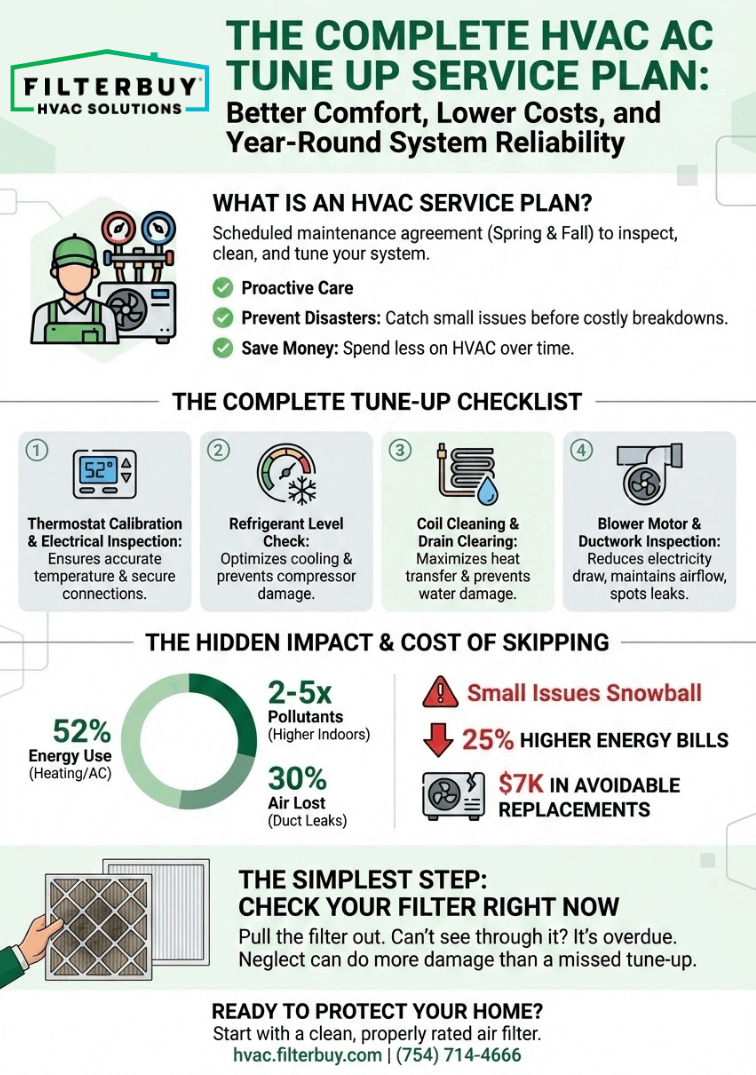
An HVAC service plan is a scheduled maintenance agreement with a licensed contractor that keeps your heating and cooling system inspected, cleaned, and tuned — typically twice a year — so small problems get caught before they turn into costly breakdowns.
What we’ve learned after servicing thousands of systems at Filterbuy HVAC Solutions:
- The homeowners who maintain a service plan almost always spend less on their HVAC over time than those who skip it
- Most emergency repairs we see trace back to something a single maintenance visit would have caught — a clogged drain, a worn capacitor, a slow refrigerant leak.
- A quality plan should cover thermostat calibration, electrical inspection, refrigerant check, coil cleaning, condensate drain clearing, blower evaluation, filter assessment, and ductwork inspection.
Top 5 Takeaways
- A real tune-up covers more than most providers deliver. Thermostat calibration. Electrical inspection. Refrigerant check. Coil cleaning. Drain clearing. Blower evaluation. Ductwork inspection.
- What happens between tune-ups matters most. We’ve seen systems lose their efficiency gains within weeks — not from mechanical failure, but from a filter that went months past its change date.
- Your HVAC system touches more than you think. Three facts from government research that match what we see in the field every week:
- Over 52% of your home’s energy use goes to heating and cooling (EIA)
- Indoor pollutant levels are often 2–5x higher than outdoor levels (EPA)
- 20–30% of conditioned air is lost through typical duct leaks (ENERGY STAR)
- Not all providers or plans are equal. Before you sign, verify four things:
- NATE-certified or EPA-certified technicians
- Written checklist of services included
- Documented findings after every visit
- No high-pressure upselling tactics
- The biggest impact starts with the simplest step. Check your filter right now. Can’t see light through it? It’s overdue. Then set up Filterbuy auto-delivery — right size, right MERV rating, right schedule — so it never falls behind again.
What Is an AC Tune-Up—and Why Does Your HVAC System Need One?
A well-maintained AC unit can run 15 to 20 years, while a neglected system often starts failing closer to the 10-year mark. That’s thousands of dollars in premature replacement costs that proactive homeowners simply avoid.
The Complete AC Tune-Up Checklist: What a Thorough Service Visit Should Cover
Based on the standards our own technicians follow, here’s what a comprehensive AC tune-up should include:
Thermostat Calibration and Settings Check — Your technician should verify that your thermostat is reading temperatures accurately and that your heating and cooling cycles are responding correctly.
Electrical Connections and Component Inspection — Loose or corroded wiring is one of the most common issues our technicians flag during service calls.
Refrigerant Level Check — Too little refrigerant and your system can’t cool effectively. Too much and you risk compressor damage.
Condensate Drain Line Clearing — A clogged condensate drain is the number one cause of water damage from HVAC systems that our technicians encounter. During a tune-up, the drain line should be flushed to prevent blockages that can lead to water backup, mold growth, and even system shutdowns triggered by the safety float switch.
Evaporator and Condenser Coil Cleaning — Dirty coils are silent efficiency killers. When dust, pollen, and debris coat your evaporator coil (inside) or condenser coil (outside), heat transfer drops, and your system has to run significantly longer to reach the set temperature.
Air Filter Evaluation and Replacement — This is the single most impactful maintenance task any homeowner can stay on top of—and the one most often neglected.
Blower Motor and Fan Inspection — The blower motor is the heart of your airflow. A tune-up should include checking the motor’s amp draw, lubricating bearings if applicable, and inspecting the fan blade for balance and cleanliness. A struggling blower motor doesn’t just reduce comfort—it increases your electricity bill every hour it runs.
Ductwork Visual Inspection — While a full duct cleaning is a separate service, your technician should visually inspect accessible ductwork for obvious leaks, disconnections, or damage.
How Often Should You Schedule an AC Tune-Up?
The industry standard recommendation is twice per year—once in the spring before cooling season and once in the fall before heating season. In our experience, this schedule works well for most homes, but some situations call for more attention. If you have pets, if anyone in your household has allergies or respiratory conditions, or if your home is in a region with heavy pollen, wildfire smoke, or high humidity, your system is working harder and accumulating contaminants faster.
The Real Cost of Skipping HVAC Maintenance
Energy bills creep up gradually, often 15–25% higher than they should be, because dirty coils, clogged filters, and misaligned components force the system to work overtime. Minor issues like a worn capacitor or a slow refrigerant leak—problems that cost under $200 to fix during a maintenance visit—escalate into compressor failures or full system replacements costing $3,000 to $7,000 or more. Indoor air quality deteriorates as dust, mold spores, and allergens cycle through an unserviced system, aggravating allergies and respiratory conditions for everyone in the household.
“The biggest misconception we encounter in the field is that an AC tune-up is optional—something you get around to when something breaks. In reality, the most expensive HVAC repairs we see almost always trace back to a minor issue that a single maintenance visit would have caught: a slow refrigerant leak, a clogged drain line, or a filter that hasn’t been changed in over a year.” — Filterbuy HVAC Solutions Service Team
7 Resources We’d Recommend to a Friend
We’re big believers that the more you know about your HVAC system, the better decisions you’ll make — for your comfort, your wallet, and the air your family breathes. That’s why we put together this list of go-to resources.
1. See What a Real Tune-Up Should Include — Not Just a Quick Filter Swap
The EPA’s ENERGY STAR Maintenance Checklist spells out every task a professional service visit should cover — thermostat calibration, electrical inspection, coil cleaning, drain clearing, and more. We keep this checklist on hand because it’s the same standard our own techs follow. If your provider’s service plan can’t match it, that’s worth knowing before you sign.
Source: ENERGY STAR Maintenance Checklist
URL: https://www.energystar.gov/saveathome/heating-cooling/maintenance-checklist
2. Stay on Top of the Easy Stuff Between Visits — Your System Will Thank You
The U.S. Department of Energy’s AC maintenance guide covers the simple things homeowners can handle themselves — swapping filters, clearing debris around the outdoor unit, and checking drain lines. Think of it as the stuff you can knock out on a Saturday morning that helps stretch the value of every service plan dollar.
Source: U.S. Department of Energy — Energy Saver
URL: https://www.energy.gov/energysaver/air-conditioner-maintenance
3. Your HVAC System Affects More Than Comfort — Here’s What It Does to Your Air
This one’s close to our hearts. At Filterbuy, we’re obsessed with indoor air quality, and the EPA’s guide connects the dots between HVAC maintenance and the air circulating through your home. It explains how ventilation, filtration, and regular system care work together to reduce allergens, pollutants, and moisture problems.
Source: U.S. EPA — Care for Your Air: A Guide to Indoor Air Quality
URL: https://www.epa.gov/indoor-air-quality-iaq/care-your-air-guide-indoor-air-quality
4. Make Sure the Person Working on Your System Actually Knows What They’re Doing
NATE (North American Technician Excellence) is the country’s largest nonprofit HVAC certification program, and its contractor locator lets you check whether a service provider employs technicians who’ve been tested on real-world knowledge. It takes two minutes and can save you from a lot of headaches down the road.
Source: NATE — Find a Certified Contractor
5. Check If Your Provider Follows the Industry’s Own Playbook
The Air Conditioning Contractors of America (ACCA) writes the standards that quality HVAC companies are supposed to follow for installation and maintenance. Their contractor directory lets you search for companies that have gone through a formal accreditation process — which means they’ve been vetted, not just licensed. It’s a great cross-reference if you want to make sure your service plan provider isn’t just cutting corners behind closed panels.
Source: ACCA — Quality Assured Contractor Directory
URL: https://hvac-contractors.acca.org/qa-contractors
6. See the Bigger Picture — How Maintenance, Efficiency, and Energy Costs All Connect
If you’re the type who likes to understand how the pieces fit together (and if you’ve read this far, you probably are), this ENERGY STAR guide is worth bookmarking. It covers how routine maintenance, duct sealing, proper equipment sizing, and energy efficiency all work as a system — and why getting one part right can make the rest work better. Especially useful if you’re weighing a service plan alongside a potential system upgrade.
Source: ENERGY STAR — Guide to Energy-Efficient Heating & Cooling (PDF)
7. Know Your Rights Before You Sign Anything — The FTC’s Guide to Service Contracts
The Federal Trade Commission’s consumer guide breaks down the difference between warranties and service contracts, what coverage questions to ask, how to spot red flags from high-pressure sellers, and when putting the money in a savings account might actually be the smarter move. We’d rather you go in with your eyes open than learn the hard way.
Source: Federal Trade Commission — Extended Warranties & Service Contracts
URL: https://consumer.ftc.gov/articles/extended-warranties-and-service-contracts
What We See in the Field — and What the Data Confirms
Here are three statistics that match our firsthand experience — and what they mean for yours.
Your HVAC System Drives More Than Half Your Energy Bill
The U.S. Energy Information Administration found that heating and air conditioning account for roughly 52% of a typical household’s annual energy use — more than lighting, appliances, and electronics combined.
What our technicians see behind that number:
- Coils caked in dust force the system to run longer cycles just to reach the set temperature
- Capacitors drawing irregular amps — a silent efficiency killer most homeowners never notice
- Filters so clogged they’re restricting airflow by 30% or more, making the entire system work overtime
Source: U.S. Energy Information Administration — Use of Energy in Homes
The Air Inside Your Home Is Likely Worse Than What’s Outside
The EPA reports that Americans spend about 90% of their time indoors, where some pollutant concentrations are two to five times higher than outdoor levels.
What you can do right now: A clean, properly rated filter is the single easiest way to reduce indoor air pollution between professional visits. It’s one of the biggest reasons we built Filterbuy around making filter changes effortless — with over 600 sizes, custom options, and auto-delivery on your schedule.
Source: U.S. Environmental Protection Agency — Indoor Air Quality Report on the Environment
Up to a Third of Your Conditioned Air May Never Reach Your Living Spaces
ENERGY STAR estimates that 20–30% of conditioned air in a typical home is lost through duct leaks, holes, and poorly connected joints
Our recommendation: Homeowners with older ductwork should check their filters every 30–45 days during peak heating and cooling months, rather than the standard 60–90 day schedule.
Source: U.S. EPA / ENERGY STAR — Duct Sealing
Final Thoughts and Opinion
After years of servicing HVAC systems, manufacturing air filters in our U.S. facilities, and talking to thousands of homeowners, we’ve arrived at a core belief:
The HVAC industry has an information problem — and homeowners are the ones paying for it.
What our technicians find in the aftermath of that approach:
- Slow refrigerant leaks nobody checked for
- Condensate drains build up toward water damage events for months
- Coils so dirty they’ve been silently inflating the energy bill by double digits
That’s not a maintenance visit. That’s a missed opportunity.
What happens when the filter is wrong or neglected:
- A clogged filter restricts airflow across the entire system
- Every component downstream works harder to compensate
- The wrong MERV rating either lets pollutants pass through or chokes the system
- Over six months of neglect, a bad filter can do more damage than a missed tune-up does in a full year
Why We Built Filterbuy the Way We Did
We wanted to eliminate every barrier between homeowners and the one maintenance task that matters most:
- Over 600 sizes — so you’re never stuck with “close enough.”
- Custom filter options — for the systems that don’t fit the standard mold
- Auto-delivery on your schedule — so the right filter shows up at your door before the old one becomes a problem
- Manufactured in the U.S. — because the thing protecting your home’s air should be built to the same standard as the home itself
Your Next Steps — Take Control of Your Home’s Comfort, Air Quality, and Efficiency
You’ve got the knowledge. Now put it to work. These are the same steps our Filterbuy HVAC Solutions team recommends to every homeowner — in the order that delivers the fastest impact.
Step 1: Check Your Current Air Filter Right Now
Takes less than two minutes. Tells you more than you’d expect.
- Pull the filter out and hold it up to the light. Can’t see through it? It’s overdue
- Note the size printed on the frame — you’ll need this for your replacement
- Check the MERV rating. Pets, allergies, or respiratory concerns in the house? Anything below MERV 8 likely isn’t capturing what matters
Not sure what you need? Our online size finder matches your exact dimensions in a few clicks.
→ Find your filter size at Filterbuy.com
Step 2: Set a Filter Change Schedule You’ll Actually Keep
The best filter doesn’t help if it sits in the system three months past its useful life.
Our field-tested recommendations:
- Every 30–45 days — multiple pets, allergies, or heavy dust/pollen
- Every 60 days, one pet or moderate seasonal allergens
- Every 90 days — no pets, no specific air quality concerns
Step 3: Schedule Your Professional Tune-Up
More than 12 months since your last service visit? Book it now.
Questions to ask any provider before you commit:
- Can you give me a written list of everything included?
- Are your technicians NATE-certified or EPA-certified?
- Will I get a written summary of findings after the visit?
- Do you inspect the condensate drain, coils, electrical, and ductwork?
Step 4: Do a 15-Minute Seasonal Walkthrough
No technician required. Just a quick check once per season:
- Outdoor unit — clear two feet of space on all sides. Remove leaves, debris, and vegetation
- Vents — confirm none are blocked by furniture, curtains, or rugs
- Thermostat — verify it reads accurately, and cycles respond correctly
- Warning signs — unusual noises, uneven room temperatures, musty smells, or a sudden energy bill spike all mean something needs attention before your next visit.
Step 5: Bookmark Your Resources
You’ve done more homework than most homeowners ever will. Keep the momentum:
- Save this page — reference the checklist before your next service appointment
- Bookmark the ENERGY STAR Maintenance Checklist — your benchmark for what a thorough visit covers
- Check your local AQI — Filterbuy’s live Air Quality Index map shows real-time conditions so you can adjust your filter schedule during high-pollen, smoke, or pollution events.
FAQ on “HVAC Service Plan”
Q: What is an HVAC service plan, and what should it include?
A: An HVAC service plan is a scheduled maintenance agreement with a licensed contractor that ensures your system gets professional care before small issues become expensive ones. Not all plans are built the same, though. We’ve seen providers sell “tune-ups” that amount to a filter swap and a thermostat glance. That’s not maintenance — that’s a receipt.
What our Filterbuy HVAC Solutions technicians cover on every visit:
- Thermostat calibration and settings verification
- Full electrical connection inspection with voltage and amp readings
- Refrigerant level check against manufacturer specs
- Condensate drain line clearing — the number one cause of HVAC water damage we encounter
- Evaporator and condenser coil cleaning
- Blower motor and fan evaluation
- Air filter assessment with a MERV rating recommendation tailored to the household
- Visual ductwork inspection for leaks and disconnections
Q: How much does an HVAC service plan cost — and is it actually worth it?
A: Most plans cost $150–$300 per year. The pattern is always the same:
- Small problem, easy fix, low cost
- Neglected problem, emergency call, big bill
In our experience, homeowners who maintain a service plan almost always come out ahead — and that’s before factoring in the lower energy bills from a system running at peak efficiency.
Q: How often should HVAC maintenance be performed under a service plan?
A: Twice a year is the standard we follow and recommend:
- Spring — cooling system service before summer demand
- Fall — heating system service before winter demand
Our recommendation for these homes: Check your filter every 30–45 days between professional visits. We’ve seen firsthand how quickly a saturated filter undoes everything a tune-up was designed to protect.
Q: What’s the difference between an HVAC service plan and a home warranty?
A: This is one of the most common points of confusion we hear — and getting it wrong can cost real money.
The key distinction:
- Service plan = proactive. Pays for scheduled maintenance to keep your system healthy and catch problems early. Think preventive care
- Home warranty = reactive. A separate contract that kicks in after something breaks, covering some or all of the repair or replacement cost
Our recommendation:
- If budget allows — have both
- If you have to choose one, start with the service plan
- Systems that get regular maintenance rarely need the emergency intervention that a warranty is designed for
Prevention costs less than repair. Every time.
Q: What should I look for when choosing an HVAC service plan provider?
A: We’ve heard too many stories from homeowners who paid for a plan and got a clipboard walkthrough and a pitch for a new system. Here’s what separates a provider worth trusting from one worth avoiding:
- Ask about technician certifications
- Request a written checklist before you sign
- Expect written findings after every visit
- Watch for high-pressure tactics
- Look for providers who ask about your household
Ready to Protect Your Home’s Comfort, Air Quality, and HVAC Investment?
Start with the step that keeps everything on this checklist working — a clean, properly rated air filter changed on schedule. Find your exact size, choose the right MERV rating for your household, and set up auto-delivery at Filterbuy.com so you never have to think about it again.