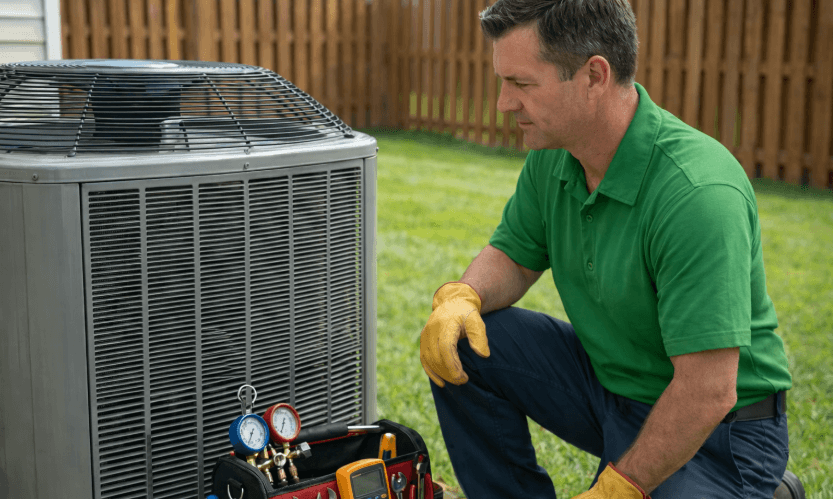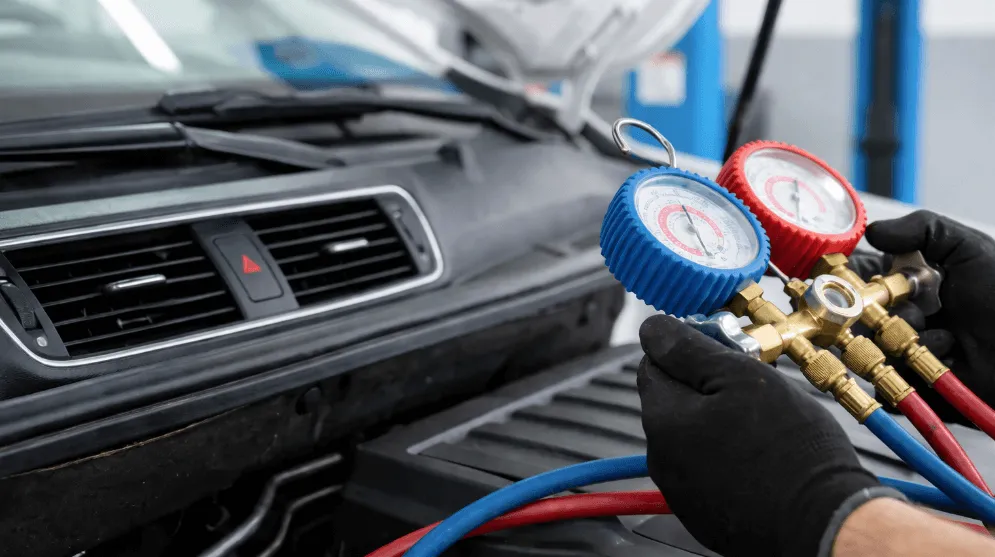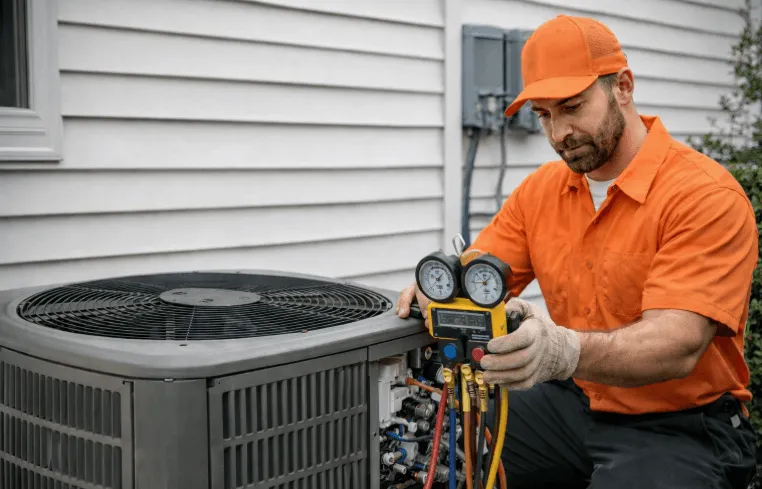


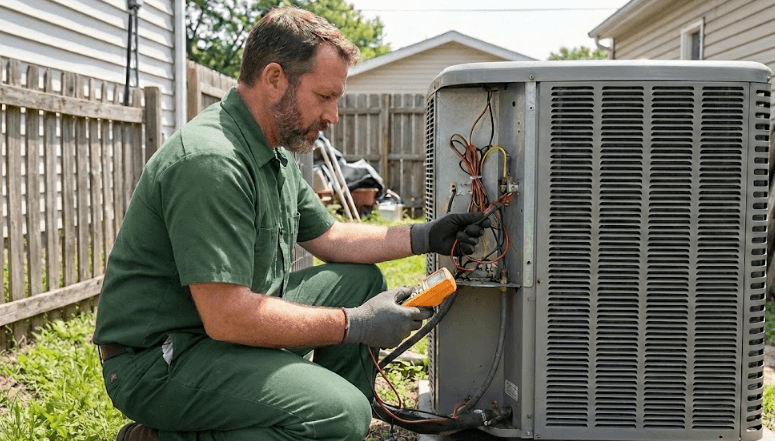
Wondering what an HVAC tune-up should cost in Florida? The short answer is $75 to $200 — but that number tells you almost nothing without context. After servicing thousands of HVAC systems across Florida communities, our technicians can tell you that a tune-up here isn’t the same service as a tune-up in Ohio or Colorado. Florida’s relentless humidity, salt air exposure along the coasts, and systems that run nearly 12 months a year create wear patterns we simply don’t see in milder climates. That means a proper Florida tune-up should address issues most out-of-state pricing guides completely overlook.
We built this guide from what we actually see in Florida homes every day — not recycled national averages. Below, we break down how Florida tune-up costs compare to other states, what should be included in your service, and the local factors that impact what you’ll pay. This is the pricing clarity Florida homeowners deserve.
TL;DR Quick Answers
What Is an AC Tune-Up?
An AC tune-up is a professional maintenance service that inspects, cleans, and optimizes your air conditioning system to ensure it runs efficiently, safely, and reliably.
What it typically costs: $75 to $200 nationally. Florida homeowners average $100 to $150.
What a proper tune-up includes:
-
- Refrigerant level check and leak inspection
- Condensate drain line flush and clearing
- Evaporator and condenser coil assessment
- Electrical connection and capacitor testing
- Air filter inspection and replacement recommendation
- Thermostat calibration
- Overall system performance evaluation
How often you need one: At least once per year. In Florida, where systems run 10 to 12 months straight, many homes benefit from twice-a-year service.
Why it matters in Florida specifically:
Our technicians see it firsthand every week — Florida’s humidity, salt air, and near year-round runtime create wear patterns that don’t exist in milder climates. A tune-up designed for Florida should address condensate drainage, coil condition, and refrigerant levels at a minimum. These are the three areas where we trace the majority of preventable system failures across the Florida homes we service.
Bottom line: A $100 to $150 annual tune-up routinely prevents $500 to $2,000 in emergency repairs. The cheapest option isn’t always the best value — the most important factor is choosing a licensed local provider who understands what Florida’s climate does to your system.
Top Takeaways
- Florida tune-ups cost $75 to $200, but price alone tells you almost nothing. A proper tune-up here must address what other states don’t face:
-
- Humidity-driven wear on coils and drain lines
- Salt air corrosion in coastal areas
- Condensate buildup from near year-round operation
- Component strain from 10 to 12 months of continuous runtime
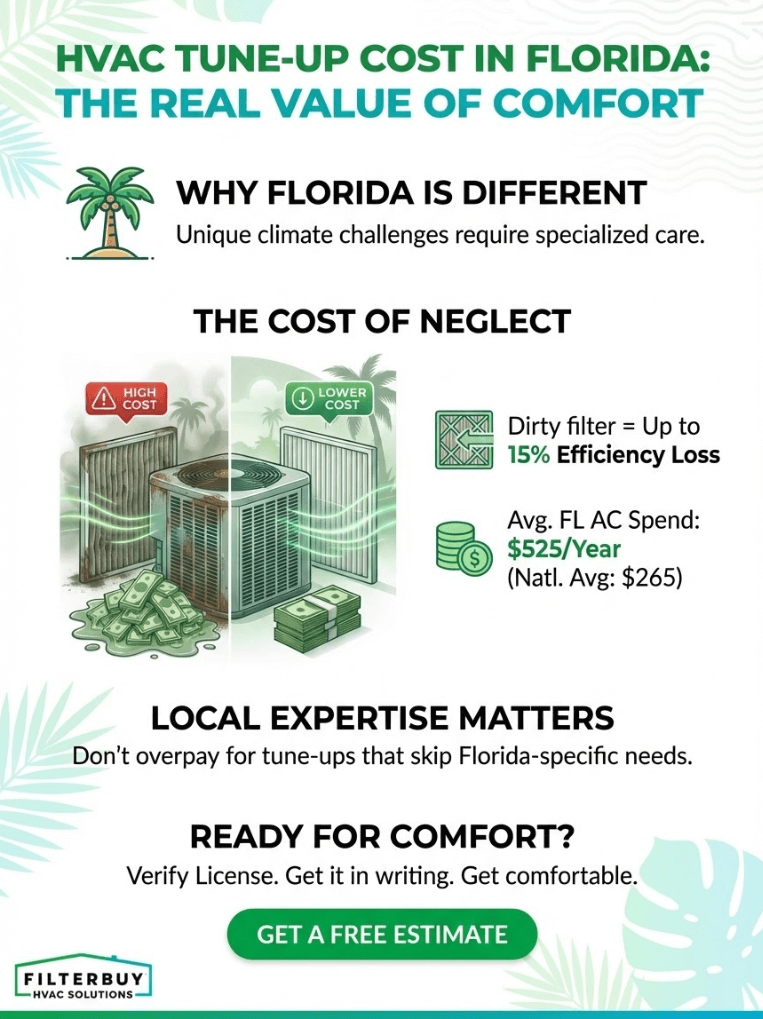
- Southeast homeowners already pay nearly double the national average for AC. Florida households spend roughly $525 per year on air conditioning, versus the national average of $265. Every percentage point of lost efficiency costs you more here than almost anywhere else.
- Dirt and neglect are the number one causes of system failure. ENERGY STAR confirms that a dirty filter alone can cut efficiency by up to 15%. In Florida’s humid, high-particulate environment, filters clog faster than the manufacturer’s timeline suggests — often in four to six weeks during peak summer.
- Local experience directly impacts service quality. A technician who knows Florida-specific wear patterns will catch what a generalist running a standard checklist might miss:
-
- Failing capacitors under continuous heat stress
- Corroding coil connections from salt air exposure
- Condensate lines approaching full restriction
- Verify your contractor and know what should be included before you book. Two steps every Florida homeowner should take:
-
- Confirm your provider’s credentials on the Florida DBPR license portal
- Compare their scope of work against the ENERGY STAR maintenance checklist and ACCA Standard 4
These are the same benchmarks we follow in every Florida home we service.
What a Standard HVAC Tune-Up Costs in Florida
Most Florida homeowners pay between $75 and $200 for a single-system tune-up, with the average landing around $100 to $150. If you have a dual system — one for heating and one for cooling — expect to pay toward the higher end or see separate charges for each unit. These numbers are consistent with what we quote across the Florida communities we serve, though pricing varies by provider, system age, and the scope of the inspection.
One thing we always tell homeowners: the cheapest quote isn’t always the best value. We’ve followed up on plenty of bargain tune-ups where the technician spent 15 minutes, checked a few boxes, and missed the early signs of compressor strain or refrigerant issues that end up costing thousands later.
How Florida Compares to Other States
Nationally, HVAC tune-up costs generally fall between $70 and $200, so Florida’s range looks similar on paper. But the comparison isn’t apples to apples. Here’s how costs break down by region based on industry averages and what we see in practice:
- Southeast (FL, GA, TX, LA): $85–$200 — higher demand and year-round system use push pricing up
- Northeast (NY, NJ, PA, MA): $100–$250 — seasonal heating-focused tune-ups with higher labor costs
- Midwest (OH, IL, MI, IN): $70–$175 — moderate demand with lower cost of living
- West Coast (CA, WA, OR): $90–$225 — varies widely based on coastal vs. inland climate
- Mountain/Plains (CO, UT, MT): $65–$160 — shorter cooling seasons mean less system wear
Florida falls in the middle on raw price, but the frequency and intensity of service needed here make the annual cost of HVAC ownership higher than in most states. A system running 10 to 12 months a year simply degrades faster than one that runs five or six.
Why Florida Tune-Ups Are Different
Florida’s climate creates HVAC challenges that don’t exist in most of the country, and a quality tune-up here should account for all of them. From our years of working in Florida homes, these are the biggest factors that separate a Florida-specific service from a generic one:
Humidity and moisture load. Florida’s average humidity means your system handles far more moisture removal than a unit in a dry climate. Drain lines clog, evaporator coils develop buildup, and condensate pans corrode faster. A proper Florida tune-up inspects and clears all of these — something that barely registers in a Colorado service checklist.
Salt air corrosion. Coastal Florida homes deal with salt air that accelerates corrosion on condenser coils, electrical connections, and cabinet housings. We routinely find corrosion damage in systems that are only three to five years old along the coast, something an inland technician might never encounter in an entire career.
Near year-round runtime. Most Florida systems rarely get a full off-season. That continuous operation means more mechanical wear, faster refrigerant depletion, and greater strain on capacitors and fan motors. Our technicians check these components closely because we know they fail earlier in Florida than the manufacturer’s timeline suggests.
Pest and debris intrusion. Florida’s environment means lizards, insects, and organic debris regularly find their way into outdoor units and ductwork. It sounds minor, but we’ve traced electrical shorts and airflow restrictions back to pest intrusion more times than you’d expect.
What Should Be Included in a Florida Tune-Up
Not every tune-up is created equal. Based on what we know, Florida systems actually need a thorough tune-up that should include:
-
- Thermostat calibration and operation check
- Electrical connection inspection and tightening
- Capacitor and contactor testing
- Refrigerant level check and leak inspection
- Evaporator and condenser coil cleaning or assessment
- Condensate drain line flush and clearing
- Blower motor and fan blade inspection
- System safety control testing
- Overall performance and efficiency evaluation
If a provider’s tune-up doesn’t address condensate drainage, coil condition, and refrigerant levels at a minimum, they’re not servicing your system for Florida’s reality. Those are the three areas where we see the most preventable failures in this climate.
Factors That Affect What You’ll Pay
Several variables can push your tune-up cost above or below the average range:
System age and condition. Older systems or units that haven’t been maintained regularly often require more time and attention. A technician may discover issues during the tune-up that need to be flagged or addressed, which can extend the service.
System type and complexity. Heat pumps, dual-fuel systems, and ductless mini-splits each have unique service requirements. A standard split-system AC tune-up is typically the baseline price, with more complex setups costing more.
Location within Florida. Labor rates vary across the state. South Florida and metro areas like Miami, Tampa, and Orlando tend to run higher than rural or North Florida markets due to the cost of living and demand.
Time of year. Scheduling a tune-up in the spring or fall — before peak heating or cooling season — can sometimes save you money and guarantee faster scheduling. During the summer rush, availability tightens, and some providers adjust pricing accordingly.
Service agreement or membership. Many providers, including our own Care Club, offer discounted tune-ups as part of an annual maintenance plan. These plans typically bring per-visit costs down and include priority scheduling and additional perks.
How to Get Real Value From Your Tune-Up
Price matters, but what you’re actually getting for that price matters more. Here’s what we recommend based on what we’ve learned serving Florida homeowners:
Ask what’s included before you book. A $79 tune-up that skips coil inspection and refrigerant checks isn’t saving you money — it’s deferring problems. Get a clear breakdown of the service scope upfront.
Choose a provider who knows Florida systems. Local experience isn’t a marketing line — it directly impacts the quality of your service. A technician who understands Florida-specific wear patterns will catch issues that a generalist might miss entirely.
Don’t skip the tune-up because the system “seems fine.” The most expensive HVAC repairs we see are the ones that could have been caught early. In Florida’s demanding climate, a system can go from running smoothly to failing a compressor in a single summer without any warning signs that a homeowner would notice.
Schedule annually at a minimum. For most Florida homes, one tune-up per year is the baseline. Homes with older systems, pets, or family members with allergies often benefit from biannual service to stay ahead of buildup and wear.
“After years of servicing HVAC systems across Florida, we can tell you that a tune-up here isn’t the same as a tune-up anywhere else — our humidity, salt air, and near year-round runtime create wear patterns that most standard checklists weren’t designed to catch, and that’s exactly why local experience matters more than price when choosing a provider.” — Filterbuy HVAC Solutions Service Team
Essential Resources on AC Tune-Ups
As your neighbors who happen to be HVAC professionals, we believe you deserve access to the same trusted resources we rely on every day. After years of servicing systems across Florida, we’ve found that the best-informed homeowners make the best decisions for their families — and these seven resources from federal agencies and national industry organizations are where we’d point any neighbor who asked us where to start.
1. Understand What a Professional Tune-Up Should Include
When a neighbor asks us what should actually happen during a tune-up, this is the resource we point them to first. The DOE’s official guide covers every core maintenance task — from filter replacement and coil cleaning to condensate drain care and refrigerant line inspection. Living here in Florida, where our systems run nearly year-round, every one of these steps matters more than it would in a milder climate. We use this as our own baseline, and you should too.
U.S. Department of Energy — Air Conditioner Maintenance
Source: https://www.energy.gov/energysaver/air-conditioner-maintenance
2. Compare Your Service Quote Against the Federal Checklist
Here’s something we tell every homeowner we work with: before you sign off on any tune-up quote, know what should be included. This task-by-task checklist details exactly what a qualified contractor should perform — electrical connection tightening, refrigerant level checks, blower component adjustments, and more. We’ve seen too many Florida homeowners pay for a “tune-up” that skipped half these steps. Print this out and hold your provider accountable — including us.
ENERGY STAR — HVAC Maintenance Checklist
Source: https://www.energystar.gov/saveathome/heating-cooling/maintenance-checklist
3. Reduce Energy Costs Beyond a Single Tune-Up
A tune-up is a great start, but it’s not the whole picture — especially in Florida, where your system carries a heavier load than most of the country. This resource covers the longer-term efficiency strategies we regularly discuss with our neighbors: duct sealing, smart thermostat optimization, filter schedules, and honest guidance on when replacement makes more financial sense than another round of repairs. We genuinely care about your comfort and your budget, and this guide helps with both.
ENERGY STAR — How to Keep Your HVAC System Working Efficiently
Source: https://www.energystar.gov/products/ask-the-experts/how-keep-your-hvac-system-working-efficiently
4. Learn How AC Maintenance Protects Your Family’s Health
This one is personal for us. Living in Florida ourselves, we know the humidity and air quality challenges our families face every day. The EPA’s homeowner guide explains the direct connection between routine HVAC maintenance and the air your family breathes — covering indoor pollutant sources, the role of filtration and ventilation, and why something as simple as regular filter changes can make a real difference in your household’s health. It’s the kind of information we wish every Florida homeowner had.
U.S. EPA — Care for Your Air: A Guide to Indoor Air Quality
Source: https://www.epa.gov/indoor-air-quality-iaq/care-your-air-guide-indoor-air-quality
5. Know the Industry Standard for a Legitimate Tune-Up
After years of working in Florida homes, we can tell you that not all tune-ups are created equal. The Air Conditioning Contractors of America developed this nationally recognized, manufacturer-endorsed standard that defines the minimum inspection tasks every residential maintenance visit should include. It’s the benchmark we hold ourselves to — and honestly, it’s the best tool you have for evaluating whether a service quote reflects thorough work or a rushed 15-minute walkthrough. As your trusted local HVAC experts, we want you to know what real maintenance looks like.
ACCA — Quality Maintenance of Residential HVAC Systems (Standard 4)
Source: https://www.acca.org/standards/quality
6. Verify Your Florida HVAC Contractor’s License Before You Hire
We’ll be straightforward with you: not everyone who knocks on your door or runs an ad online is properly licensed to work on your system. Florida law requires all HVAC contractors to hold a license through the Department of Business and Professional Regulation, and this free lookup tool lets you verify any provider in seconds. Based on our years serving this community, we’ve seen the damage unlicensed work can cause — voided warranties, failed inspections, and repairs that cost far more to fix than the original problem. Check every contractor before you hire, and start with this tool.
Florida DBPR — HVAC Contractor License Verification Portal
Source: https://www.myfloridalicense.com/wl11.asp
7. Protect Yourself from Contractor Fraud and Overcharging
We genuinely care about our neighbors, and that means looking out for you even when the advice doesn’t directly involve our services. The Federal Trade Commission’s consumer guide covers the warning signs of contractor fraud — pressure tactics, suspicious payment requests, and missing insurance — along with where to file a complaint if something goes wrong. In our experience working in Florida communities, the homeowners who take five minutes to read this guide before hiring save themselves real headaches down the road. You deserve honest, transparent service every time.
FTC — How to Avoid a Home Improvement Scam
Source: https://www.consumer.ftc.gov/articles/0242-hiring-contractor
Supporting Statistics
We don’t just quote numbers — we live them. These federal statistics line up with what our technicians document in Florida homes week after week.
Nearly Half of Your Energy Bill Goes to Heating and Cooling
ENERGY STAR reports that the average U.S. home spends close to $1,900 per year on energy, with nearly half going to heating and cooling. They also identify dirt and neglect as the number one causes of system failure.
In Florida, we see both realities collide constantly:
- Systems caked with buildup from humidity and coastal air
- Units running 10 to 12 months straight with no professional attention
- Higher bills, weaker airflow, and components working far harder than they should
When we walk into a home where the system hasn’t been serviced in two or three years, the signs are almost always the same. A proper tune-up addresses every one of these issues before they become a repair call.
Source: https://www.energystar.gov/products/ask-the-experts/how-keep-your-hvac-system-working-efficiently
A Dirty Filter Alone Can Cut Efficiency by Up to 15%
The U.S. Department of Energy states that clogged filters restrict airflow and can reduce your AC’s efficiency by as much as 15%. In Florida, the problem accelerates.
Our technicians routinely find filters that are completely saturated — not from neglect, but because Florida’s environment overwhelms them faster than most homeowners expect:
- Humidity drives moisture into filter media year-round
- Pollen cycles and particulate levels are higher than in most U.S. regions
- A filter lasting three months in Colorado may need replacing in four to six weeks here during peak summer
That’s why filter inspection is the first thing we check during every tune-up. In our experience, it’s the single fastest efficiency win a Florida homeowner can get.
Source: https://www.energy.gov/energysaver/air-conditioner-maintenance
Southeast Homeowners Spend Nearly Double the National Average on AC
The U.S. Energy Information Administration reports that households in the hot-humid Southeast — including all of Florida — spent an average of $525 per year on air conditioning. The national average is just $265.
That gap doesn’t surprise us. When we service a Florida home that hasn’t been tuned up in over a year, we typically find:
- Condensate lines are starting to restrict
- Evaporator coils carrying buildup that reduces heat absorption
- Capacitors under stress from months of continuous operation
Each issue chips away at efficiency. When your AC costs already run nearly double the national average, every percentage point of lost performance hits your wallet harder than almost anywhere else in the country.
Source: https://www.eia.gov/todayinenergy/detail.php?id=36692
Final Thought: Why the Cheapest Tune-Up in Florida Is Rarely the Best Value
Here’s the truth after years of servicing HVAC systems across Florida communities: the cost of a tune-up matters far less than what actually happens during that tune-up.
We’ve followed up on countless service calls where a homeowner paid $49 or $59 for a “tune-up special” — only to find the technician spent 15 minutes onsite and missed the warning signs that end up costing hundreds or thousands later:
- A failing capacitor that could have been caught early
- A condensate line is one month from backing up into the ceiling
- Refrigerant is slowly leaking from a corroded coil connection
These aren’t hypotheticals. They’re issues we document in Florida homes every single week.
The national averages and state-by-state comparisons in this guide give you a useful pricing framework. The federal resources show you exactly what a legitimate tune-up should include and how to verify your contractor. But no pricing guide can tell you whether the person servicing your system actually understands what Florida does to HVAC equipment.
Our honest perspective: A $150 tune-up from a licensed local technician who understands how Florida’s humidity, salt air, and year-round runtime affect your specific system will save you more money over time than a $79 deal from a provider running a generic checklist designed for a milder climate. We’ve seen it play out too many times to count.
If there’s one takeaway from this page, don’t shop for the lowest price. Shop for the provider who can:
- Tell you exactly what they’re going to inspect
- Explain why each step matters in Florida specifically
- Show you what they found when they’re done
That’s the kind of tune-up that actually protects your system, your comfort, and your budget for the long run. As your neighbors who happen to be HVAC professionals, that’s the standard we hold ourselves to — and the standard we’d encourage you to expect from anyone you invite into your home.
Next Steps: What to Do Before Your Next Tune-Up
You know what a Florida tune-up should cost, what it should include, and why local experience matters. Here’s how to put that knowledge to work.
- Verify Your Contractor’s License First Look up any provider on the Florida DBPR portal before you call. It takes less than a minute and protects you from unlicensed work that could void your warranty.
Source: https://www.myfloridalicense.com/wl11.asp
- Ask What’s Included — In Writing Request a clear task breakdown before you book. A Florida-specific tune-up should cover at a minimum:
-
- Refrigerant level check and leak inspection
- Condensate drain line flush and clearing
- Evaporator and condenser coil assessment
- Electrical connection and capacitor testing
- Filter inspection with replacement recommendation
If a provider can’t tell you exactly what’s included, that’s a red flag.
- Schedule Before Peak Season Spring and early fall are the best times to book in Florida. You’ll get better availability, potentially lower pricing, and confidence that your system is ready before it’s working its hardest.
- Check Your Filter Right Now. Pull your filter and hold it up to the light. Can’t see through it? Replace it. In Florida’s climate, filters often need changing every four to six weeks during peak summer, not the 90 days printed on the packaging.
- Consider a Maintenance Plan. Annual maintenance agreements take the guesswork out of scheduling and reduce per-visit costs. Our Care Club includes:
-
- Discounted tune-ups
- Priority scheduling
- Additional perks designed for Florida systems
- Request a Free Estimate from Filterbuy HVAC Solutions. We’d welcome the chance to be your trusted local HVAC partner. Contact us today for a free, no-obligation estimate. We’ll:
-
- Walk through your system with you
- Share honestly what we find
- Recommend only what your home actually needs
As your neighbors who live and work in your community, we bring the local knowledge and firsthand Florida experience that generic providers can’t match.
FAQ on AC Tune-Ups
Q: How much does an AC tune-up cost in Florida?
A: Most Florida homeowners pay between $75 and $200, with the average landing around $100 to $150. But that number only means something if you know what you’re getting for it.
We’ve walked into plenty of homes where the homeowner paid $49 for a “tune-up special” and the technician:
- Never touched the condensate line
- Never checked refrigerant levels
- Never opened the electrical panel
Three months later, we’re there for an emergency repair that could have been prevented. In Florida’s climate, a tune-up that skips humidity wear, coil condition, and drainage is really just a courtesy visit with a receipt.
Q: How often should you get an AC tune-up in Florida?
A: Once a year at minimum. Twice a year for many Florida homes.
The reason is straightforward — your system barely gets an off-season here. A Michigan homeowner runs their AC five months a year. Your Florida unit runs 10 to 12 months straight. That continuous operation:
- Wears down capacitors faster than manufacturer timelines suggest
- Strains fan motors beyond standard expectations
- Clogs drain lines on an accelerated schedule
We especially recommend biannual service for:
- Homes with older systems
- Households with pets that shed heavily
- Family members with allergies or respiratory concerns
Early spring, before peak cooling season, is the single best time to schedule.
Q: What should be included in a Florida AC tune-up?
A: More than most providers deliver. We built our checklist based on what we actually see failing in Florida homes — not what a generic national template suggests.
A thorough Florida-specific tune-up should include:
- Thermostat calibration and operation check
- Electrical connection inspection and tightening
- Capacitor and contactor testing
- Refrigerant level check and leak inspection
- Evaporator and condenser coil cleaning or assessment
- Condensate drain line flush and clearing
- Air filter inspection with replacement recommendation
- Blower motor and fan blade inspection
- System safety control testing
- Overall performance and efficiency evaluation
The three non-negotiables in Florida:
- Condensate drainage — the number one source of preventable water damage we see
- Coil condition — humidity drives buildup that directly reduces cooling capacity
- Refrigerant levels — salt air corrodes connections and causes slow leaks
If your provider doesn’t address all three, they’re servicing your system as if it lives somewhere with four mild seasons. It doesn’t.
Q: Is an AC tune-up worth the money?
A: Without question — and the federal data backs it up:
- ENERGY STAR identifies dirt and neglect as the top causes of system failure
- U.S. Department of Energy confirms a dirty filter alone can cut efficiency by up to 15%
- U.S. EIA reports Florida households spend roughly $525/year on AC — nearly double the $265 national average
Every point of lost efficiency costs you more here than almost anywhere else.
But the number that really tells the story is what we see in the field. The most expensive repair calls we respond to — $500, $1,000, sometimes $2,000 or more — are overwhelmingly systems where a $100 to $150 tune-up would have caught the problem months earlier:
- A burned-out compressor that started as a weak capacitor
- A water-damaged ceiling that started as a slow condensate restriction
- A frozen evaporator coil from a refrigerant leak that was detectable six months prior
We’ve seen it too many times to count. It never had to happen.
Q: How do I find a trustworthy AC tune-up provider in Florida?
A: After years of hearing from Florida homeowners who’ve been burned by cut-rate providers, here’s exactly what we recommend:
- Verify their license first. Florida requires all HVAC contractors to be licensed through the DBPR. Look them up before you pick up the phone.
- Ask for the full scope in writing. Any provider worth hiring will give you a task-by-task breakdown without hesitation. Compare it against:
- The ENERGY STAR maintenance checklist
- ACCA Standard 4 for residential HVAC maintenance
- Prioritize local experience over national branding. A technician with years of Florida-specific work will:
- Recognize salt air corrosion on a three-year-old condenser
- Know that coastal units degrade on a faster timeline
- Understand that our humidity creates drain and coil issues that don’t exist in drier states
That knowledge comes from hands-on local work, season after season — not a training manual. As your neighbors who happen to be HVAC professionals, we’d rather earn your trust with honest advice than win your business with the lowest price.
Don’t Overpay for a Tune-Up That Doesn’t Cover What Florida Systems Actually Need
Get a thorough, Florida-specific HVAC tune-up from local technicians who understand your climate — contact Filterbuy HVAC Solutions today for a free, no-obligation estimate.