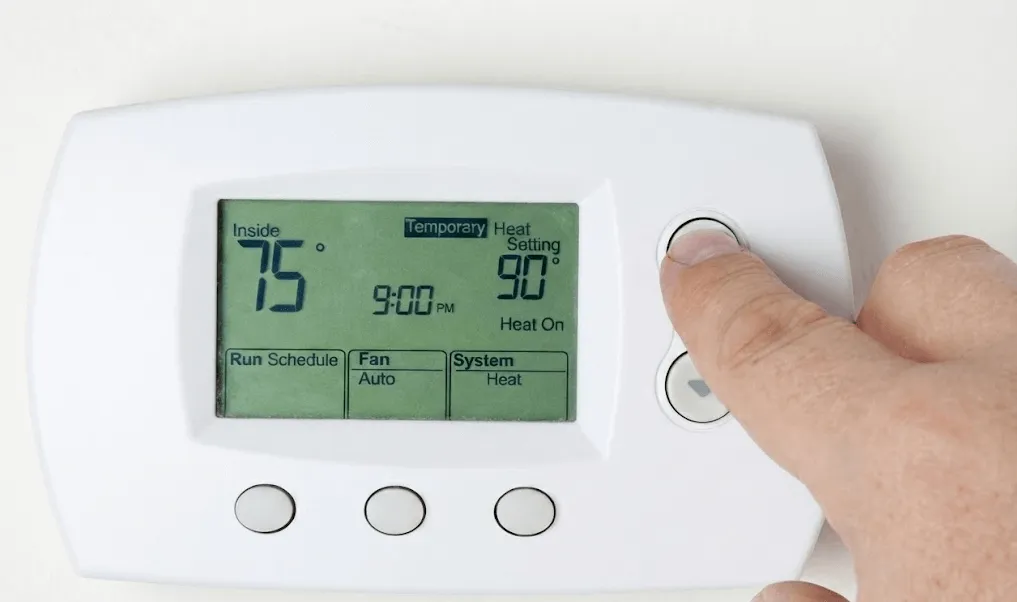




If your thermostat starts flashing HEAT or EM HEAT, it can make winter feel a little more uncertain than it needs to be. As your neighbors who’ve been helping local families stay warm for generations, we see this confusion every season. Homeowners often worry something’s wrong with their system, when in many cases, the thermostat is simply doing its job the way it was designed.
From years of troubleshooting cold-weather calls in our community, here’s what we’ve learned:
The difference between Heat and Emergency Heat has everything to do with how your heat pump works behind the scenes—and which energy source your home is relying on to stay warm.
Our goal here is to give you the kind of clear, real-world explanation we share at the kitchen table with the families we serve. No jargon. No guessing. Just neighbor-to-neighbor guidance you can trust so you can run your system confidently, avoid unnecessary energy costs, and keep your home as comfortable as it should be.
TL;DR Quick Answers
em heat vs heat
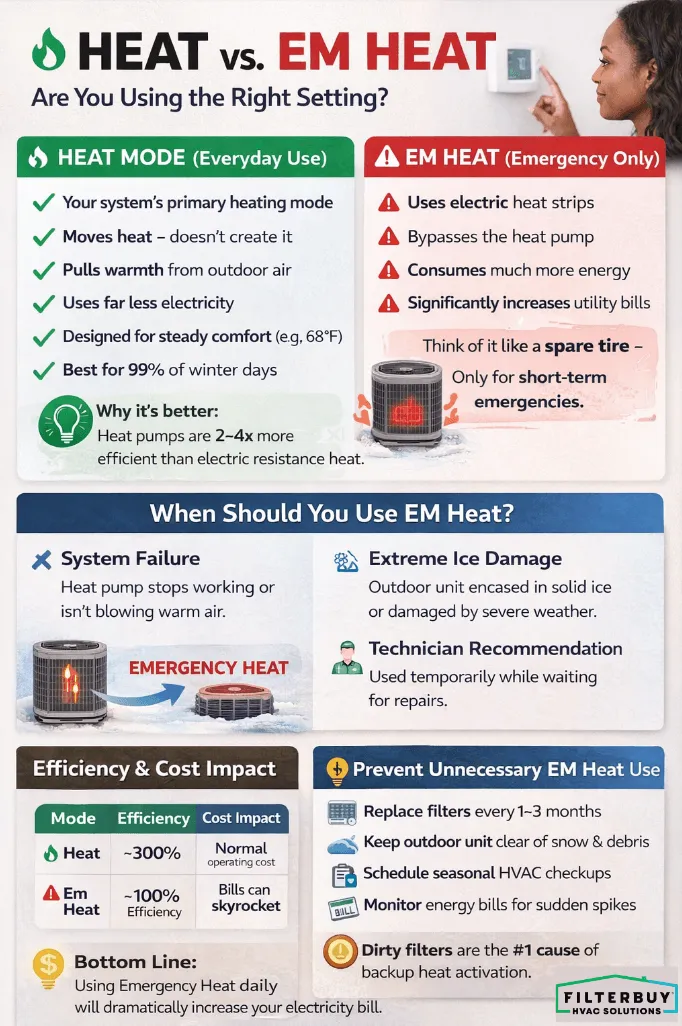
Heat is your HVAC system’s standard heating mode—your heat pump does the work, using the least amount of energy to keep your home warm.
Emergency Heat (Em Heat) is a backup setting that uses your auxiliary or electric heat strips instead of the heat pump. It’s meant for rare situations—like freezing temps or a failing outdoor unit—and costs significantly more to run.
Top 5 Takeaways
- Use regular Heat mode for everyday heating.
It’s the most efficient, least expensive option for our climate and should handle normal winter temperatures on its own.
- Save Emergency Heat for true backup situations.
Only use EM Heat when your heat pump can’t run or can’t keep up—like during a malfunction or an extreme cold spell.
- EM Heat costs significantly more to operate.
It relies on electric resistance heat, which burns through energy quickly. Think of it as your “spare tire”—helpful, but not something you want to rely on daily.
- Prevent unnecessary EM Heat use with simple maintenance.
Clean air filters and routine seasonal checkups go a long way in keeping your system efficient. In our experience, a dirty filter is one of the most common reasons a heat pump overworks and triggers backup heat.
- Smart thermostat settings protect your comfort and your budget.
Understanding how each mode works helps you heat your home more intentionally—avoiding surprise utility bills and reducing strain on your system.
Understanding How “Heat” Mode Works in Your Home
When winter settles in, your thermostat’s heat mode is the setting you’ll lean on most—and when you understand how it works, it becomes one of the most efficient tools for keeping your home warm. As your neighbors who service heat pumps all across our community, we’ve seen how well these systems perform in our local climate when they’re set up and used the right way.
In regular Heat mode, your heat pump pulls what little warmth exists outdoors and moves it into your home. Even on the colder days we get here, this process is surprisingly effective—and much more energy-friendly than people expect. Keeping your thermostat at a steady temperature allows the system to do its job without constantly ramping up and wasting energy.
From what we see in local homes every winter, Heat mode is the most cost-effective choice for day-to-day comfort. When it’s set consistently, you get reliable warmth, smoother system operation, and lower energy bills—all without putting unnecessary strain on your equipment.
What “Emergency Heat” Mode Is Really For
Emergency Heat—often labeled EM HEAT—is your system’s backup plan, not your everyday heating strategy. Think of it like calling in a neighbor to help when your main heating source can’t keep up. It’s there when you need it, but it isn’t meant to run full-time.
In our area, Emergency Heat typically engages when:
- Your heat pump stops working, or
- Outdoor temperatures drop so low that the heat pump can’t bring in enough warmth to maintain your set temperature.
Instead of using the heat pump, EM Heat relies on a secondary heat source—usually electric resistance heat. It warms your home quickly, but it does so at a much higher energy cost. After years of seeing local homeowners surprised by their winter utility bills, we always remind folks: only use Emergency Heat when your primary system can’t operate or can’t keep up. It’s a helpful safety net, not a winter-long solution.
When Heat Mode Is the Best Choice
Most days, especially in our community’s typical winter weather, your home will be most comfortable and your wallet most protected by sticking with regular Heat mode. Heat pumps are built to run efficiently in mild to moderately cold temperatures, and we see them perform well in these conditions throughout the season.
A steady thermostat setting—like keeping it around 68°F during the day—is usually enough to maintain comfort without forcing the system to cycle excessively. Pair that with good insulation and sealed drafts, and your heat pump can heat your home efficiently without relying on backup heat.
In short: If your heat pump is running normally and outdoor conditions aren’t extreme, Heat mode is the right choice.
When You Should Switch to Emergency Heat
There are only a few situations where Emergency Heat is the responsible, cost-saving choice—despite its higher energy use. Based on what we see in local homes year after year, here’s when it makes sense to activate it yourself:
- Your heat pump is malfunctioning and can’t heat your home
- Ice or damage is preventing the outdoor unit from operating.
- A severe cold snap pushes temperatures far below what your heat pump is rated to handle.
- A technician advises you to switch to EM Heat until repairs can be made.
If none of these are happening, leave the system in regular Heat mode. Switching to EM Heat too soon or too often leads to higher utility bills and unnecessary wear on a system that may not actually be in trouble.
Remember: Emergency Heat is exactly that—a backup for emergencies, not a shortcut to warmer air.
What Each Mode Means for Energy Use and Costs
Understanding the cost difference between Heat and Emergency Heat can help you make smarter decisions when temperatures drop.
Here’s what we see consistently in homes throughout our community:
Heat Mode: Efficient & Budget-Friendly
Your heat pump is simply moving heat—not generating it—so energy use stays low. On most winter days, this keeps your home warm without inflating your utility bill.
Emergency Heat: Effective but Expensive
When EM Heat takes over, your system turns to electric resistance heat (or another backup source). That process uses far more electricity. Even a few hours of unnecessary Emergency Heat can make a noticeable difference on your bill.
Our Local Advice
Use Emergency Heat only when absolutely needed.
Use Heat mode the rest of the time.
And when in doubt, we’re always happy to take a look and offer guidance—neighbor to neighbor.
“From what we’ve seen in homes across our community, Emergency Heat is often misunderstood. It’s not a ‘boost button’—it’s a true backup for those rare moments when your heat pump can’t do its job. After years of helping our neighbors sort through winter heating concerns, we’ve learned that staying in regular Heat mode keeps energy costs down and systems running the way they’re meant to. Emergency Heat should only step in when your main system can’t keep up or can’t run at all.”
Essential Resources for Understanding EM Heat vs. Heat
1. Clear Differences Explained: Emergency Heat vs. Heat Pump — North NJ HVAC
Get a straightforward breakdown of how Heat and EM Heat actually function, including how each mode impacts efficiency, comfort, and system workload—ideal for quick clarity before troubleshooting.
URL: https://northnjhvac.com/emergency-heat-versus-heat-pump-key-differences-usage/
2. When to Use EM Heat (and When Not To) — PICKHVAC
Learn the exact situations where Emergency Heat is appropriate, how it protects your system during failures or extreme cold, and how to avoid costly misuse.
URL: https://www.pickhvac.com/when-use-emergency-heat-heat-pump-signs-settings-savings/
3. Homeowner-Friendly Guide to EM Heat — House Digest
A simple, easy-to-understand explanation of what EM Heat does, why it’s expensive, and what’s happening inside your system when you turn it on.
URL: https://www.housedigest.com/1891291/what-em-heat-thermostat-really-means-when-to-use-it/
4. In-Depth FAQs on Backup Heat Systems — Home Inspection Insider
Covers the “why” behind emergency heat usage, offering practical insights into efficiency trade-offs and how your system behaves in freezing weather.
URL: https://homeinspectioninsider.com/emergency-heat/
5. Thermostat Settings Simplified: Heat vs. EM Heat — Angi
Breaks down how thermostats activate Heat vs. EM Heat and helps you understand which setting to choose based on temperature, energy costs, and system performance.
URL: https://www.angi.com/articles/emergency-heat-vs-heat.htmm
6. Aux Heat vs. Emergency Heat Explained — Appliance Mastery
Helps you quickly distinguish between “Aux Heat” (automatic support) and “Emergency Heat” (manual backup), so you know exactly what your thermostat is doing.
URL: https://appliancemastery.com/heat-pump-aux-heat-vs-emergency-heat/
7. Technical Foundation of Heat Pumps — Wikipedia (Heat Pump)
Offers foundational knowledge on how heat pumps move heat rather than create it, making it easier to understand why EM Heat consumes more energy.
URL: https://en.wikipedia.org/wiki/Heat_pump
Supporting Statistics
Heat pumps are 2–4× more efficient than electric resistance heat.
The Department of Energy confirms that air-source heat pumps deliver two to four times more heat per unit of electricity because they move heat instead of generating it.
Local takeaway:
In our community, we consistently see the best results—lower bills, steadier warmth—when homeowners stay in standard Heat mode. Switching to Emergency Heat removes that efficiency advantage and drives energy costs up quickly.
Source: energy.gov
Heating and cooling account for 52% of a home’s total energy use.
According to the U.S. Energy Information Administration, more than half of a household’s yearly energy consumption goes directly toward heating and air conditioning.
Local takeaway:
Because HVAC makes up such a big part of the average family’s utility bill, even small decisions—like avoiding unnecessary Emergency Heat—can make a meaningful difference on monthly costs.
Source: eia.gov
Heat pumps run 2–3× more efficiently than standard electric resistance systems.
ENERGY STAR research continues to show that modern air-source heat pumps outperform resistance heating in everyday operation, especially in climates like ours.
Local takeaway:
In the homes we service, we see the same pattern year after year: sticking with Heat mode keeps systems running smoothly and keeps energy bills in check. Emergency Heat should stay reserved for true system failures or rare cold-weather extremes.
Source: energystar.gov
Final Thoughts & Our Local Perspective
After years of helping families across our community navigate winter heating issues, one thing has become clear: most homeowners rarely need to rely on Emergency Heat. The name can be misleading—EM Heat isn’t stronger, faster, or “better.” It’s simply a backup meant for the moments when your heat pump can’t run or can’t keep up in extreme weather.
In day-to-day winter conditions, your heat pump is designed to handle far more than people expect. We see it all the time in local homes: when a system is maintained and running properly, standard Heat mode delivers dependable comfort with much better efficiency and lower operating costs.
Here’s the simple rule of thumb we share with our neighbors:
- Choose Heat for normal comfort and everyday efficiency.
- Choose EM Heat only when your heat pump can’t run or can’t keep up.
Why this matters:
Staying in regular Heat mode most of the time protects your energy budget, reduces unnecessary strain on your equipment, and keeps your home comfortable without surprise utility spikes. Emergency Heat has its purpose—but it should stay in your back pocket for true emergencies.
Next Steps: What We Recommend as Your Local HVAC Neighbors
- Confirm your system type.
Emergency Heat applies only to heat pumps. If you’re unsure what you have, we’re happy to help you identify it.
- Use Heat as your everyday setting.
For our local climate, this is the most efficient and cost-effective way to stay warm.
- Switch to EM Heat only when needed.
Turn it on if your heat pump isn’t running, can’t maintain temperature, or shows signs of failure.
- Check your outdoor unit.
Look for heavy frost, unusual noises, or a unit that isn’t turning on—these are common signs your system needs attention.
A dirty filter is one of the most common reasons we see heat pumps struggle or trigger EM Heat unnecessarily. Swap it every 1–3 months.
- Keep an eye on your energy bills.
A sudden jump often tells us your system may be relying too heavily on backup heat.
- Schedule a heat-pump checkup.
If EM Heat turns on frequently, it’s worth having a trusted local HVAC tech take a look before a small issue becomes a bigger one.
- Stay informed.
The more you understand your thermostat and system, the more confidently you can manage winter comfort. Explore our other guides for practical, neighbor-to-neighbor advice.
Frequently Asked Questions
Q: What’s the difference between Heat and EM Heat?
A: Heat: Use your heat pump—efficient and ideal for daily use.
EM Heat: Bypasses the heat pump and uses a backup heat source that costs more to run.
Q: When should I use EM Heat?
A: Only when the heat pump is frozen, failing, or not turning on. Otherwise, stick with regular Heat mode.
Q: Does EM Heat warm the house faster?
A: No. It’s not a “boost”—it’s simply a less efficient backup heat source.
Q: Why does Emergency Heat raise my energy bill?
A: It relies on electric resistance heating, which uses significantly more power than your heat pump.
Q: Why does EM Heat sometimes turn on automatically?
A: Your system is signaling that the heat pump is struggling—usually due to extreme cold, a dirty filter, or a developing system issue that needs attention.
Not Sure If Your Thermostat Is Set to Heat or Emergency Heat Mode? Let Your Neighbors Help You Get It Right.
Schedule a free consultation with Filterbuy HVAC Solutions today—we’ll check your thermostat settings, inspect your heat pump, and make sure your system is running in the right mode so you stay comfortable without overpaying on energy bills.