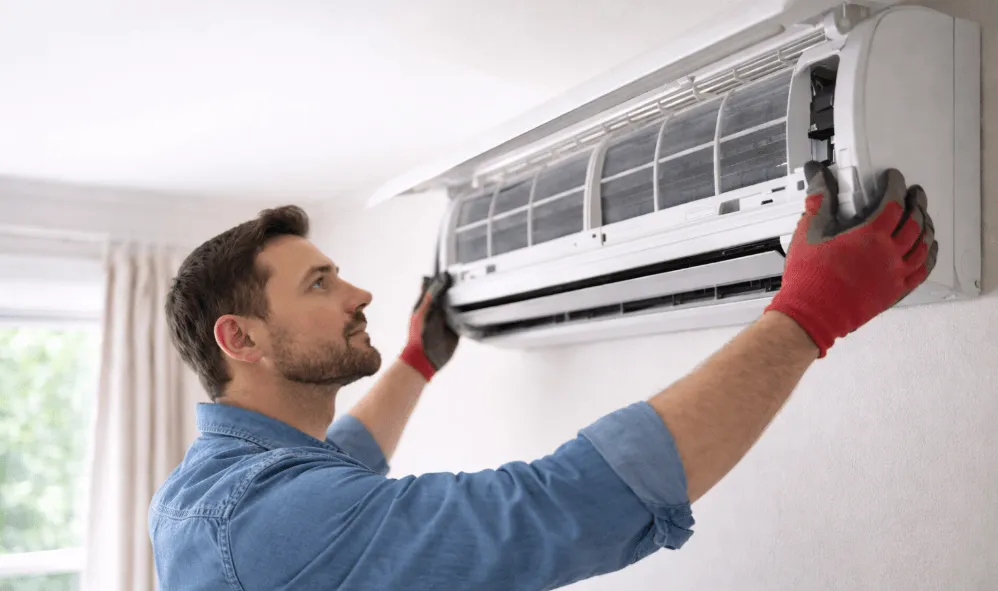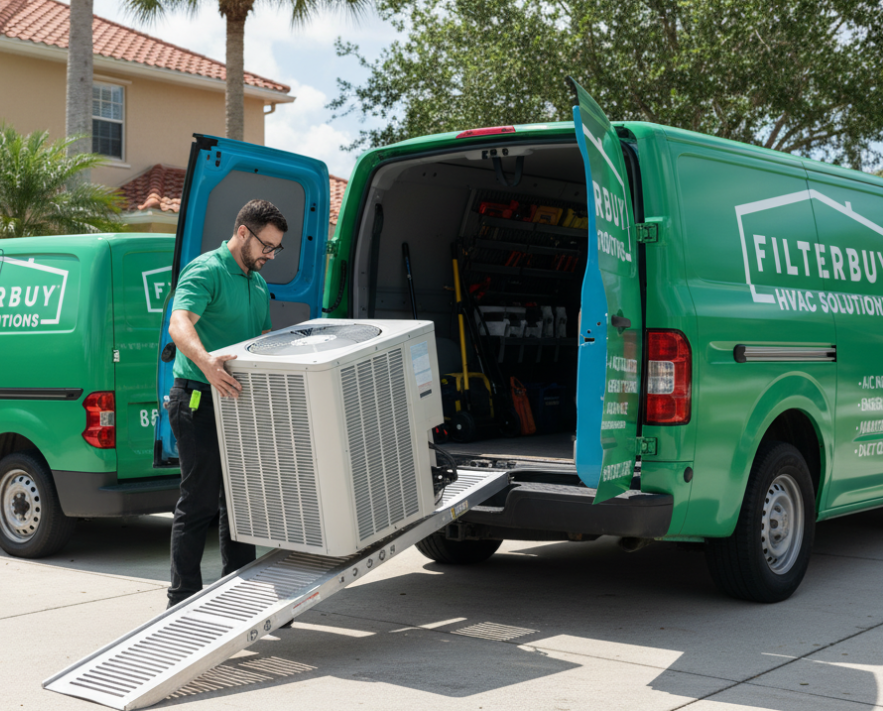



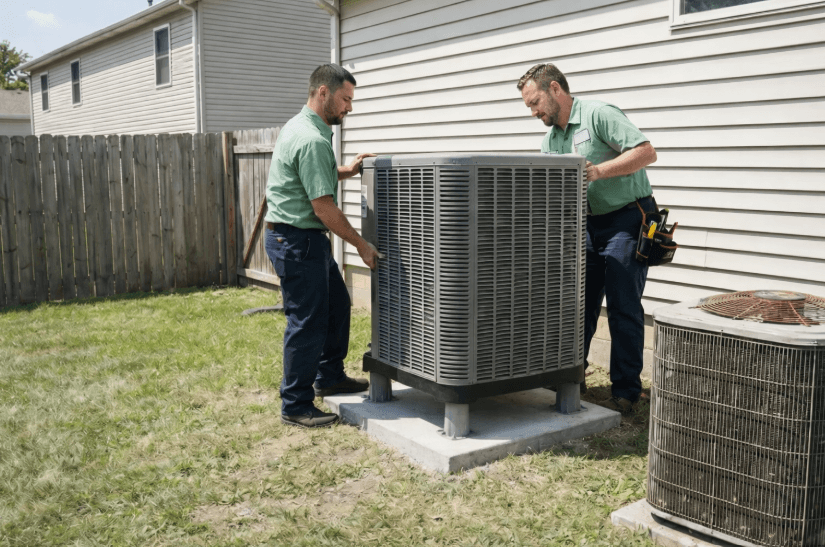
When your central AC starts struggling, the replacement decision you make next will impact your comfort — and your energy bills — for the next 15 to 20 years. After helping millions of homeowners protect their HVAC systems through our U.S.-manufactured air filtration products and services, we’ve seen firsthand what happens when a replacement goes wrong: oversized units that short-cycle and drive up humidity, undersized systems that run nonstop and burn out early, and homeowners who paid top dollar for efficiency ratings they’ll never recoup.
Here’s what most contractor quotes won’t tell you: the timing of your purchase, the accuracy of your home’s load calculation, and your understanding of what SEER2 ratings actually mean in real-world savings matter just as much as the brand name on the box. This guide walks you through all of it — costs, sizing, efficiency, and timing — so you can make the kind of informed decision that protects your home, your budget, and your system for the long haul.
TL;DR Quick Answers
What should every homeowner know about central AC replacement?
The short version from our team at Filterbuy, after helping millions of homeowners protect their HVAC systems:
- Typical cost: $3,800–$12,500 depending on system size, efficiency, and installation complexity
- Average lifespan: 15–20 years for a properly maintained central AC
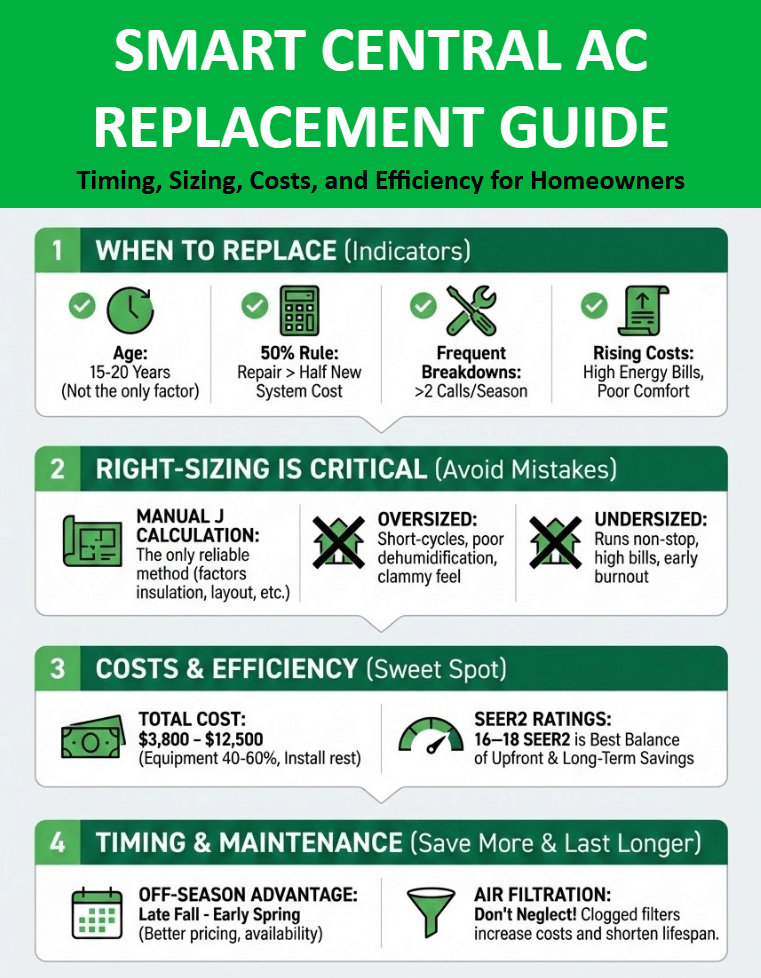
- Replace when: Repairs exceed 50% of the new unit cost, the system uses R-22 refrigerant, or you’re calling for service more than twice per cooling season.
- Right sizing matters most: A Manual J load calculation — not a square footage guess — is the only reliable way to determine correct tonnage.
- Efficiency sweet spot: 16–18 SEER2 for most homes; 20+ SEER2 only pays off in high-cooling climates with extended payback timelines
- Best time to buy: Late fall through early spring, when contractors are flexible on pricing and scheduling
- The #1 mistake we see: Homeowners invest thousands in a new system, then neglect the filter — restricting airflow, raising energy costs, and shortening equipment life
Top 5 Takeaways
- Sizing trumps brand name. Insist on a Manual J load calculation. Oversized units short-cycle and trap humidity. Undersized units run nonstop and burn out early. No calculation? Find another contractor.
- SEER2 ratings don’t work alone. The 16–18 range is the sweet spot for most homes. But even premium ratings underperform with leaky ducts or a dirty filter. Efficiency is a system-wide outcome.
- Timing saves thousands. Buy in the off-season — late fall through early spring. Better pricing, more contractor availability, zero pressure.
- Installation is the starting line, not the finish. The homeowners who protect their investment with a clean, properly fitted filter on a consistent schedule are the ones who get 15–20 years of peak performance.
- Your AC is also your air quality system. Indoor pollutants run 2–5x higher than outdoor levels. A well-maintained central AC paired with the right filter isn’t just about comfort — it’s about your family’s health.
When Repair Stops Making Sense
Most central AC systems last 15 to 20 years, but age alone isn’t the whole picture. The real warning signs tend to stack up: frequent repairs (more than two per cooling season), the now-phased-out R-22 refrigerant, rising energy bills, or rooms that just won’t stay comfortable during peak heat. A good rule of thumb — if a single repair costs more than half of what a new system would run, replacement is the smarter financial move.
What Replacement Actually Costs
Central AC replacement typically falls between $3,800 and $12,500 for most homes. That wide range reflects real differences in system size, efficiency tier, installation complexity, and local labor rates.
The equipment — outdoor condenser and indoor evaporator coil — accounts for roughly 40% to 60% of the total. Labor covers the rest, including electrical connections, refrigerant lines, and sometimes ductwork modifications. What catches many homeowners off guard are the extras: permits, thermostat upgrades, duct sealing, and old-unit disposal.
SEER2 Ratings — What Actually Saves You Money
SEER2 (Seasonal Energy Efficiency Ratio 2) replaced the old SEER standard in 2023 and measures how efficiently your AC converts electricity into cooling across an entire season. Higher numbers mean lower utility bills, but there’s a practical limit to the return.
The current federal minimum is 14.3 SEER2 in northern states and 15 SEER2 in southern states. Mid-range units (16–18 SEER2) tend to deliver the best balance of upfront investment and long-term savings. Premium 20+ SEER2 systems can cut cooling costs significantly, but the payback period may stretch beyond 10 years depending on your climate and electricity rates.
Here’s the part most guides skip: a high SEER2 rating only performs to its potential when the rest of your system supports it. That means sealed ductwork, correct refrigerant charge, and — this is where our expertise comes in — consistently using the right air filter on the right change schedule. A clogged or poorly fitted filter forces even the most efficient unit to work harder, driving up costs and shortening equipment life.
Time It Right to Save More
If your system is still limping along, you have a strategic advantage over emergency buyers: timing. The worst time to purchase is mid-heat wave, when contractors are booked solid and discounts disappear.
The sweet spot is late fall through early spring. During the HVAC off-season, contractors are more likely to offer competitive pricing, financing promotions, or priority scheduling. Manufacturers also release new models in spring, which can push previous-year units to reduced prices.
Plan use the cooler months to collect quotes, compare systems, and lock in your install date well before the first summer spike.
“After more than a decade of manufacturing air filters in the U.S. and helping millions of homeowners protect their HVAC systems, we’ve learned that the most expensive mistake isn’t choosing the wrong AC brand — it’s neglecting the basics like proper sizing and consistent filter maintenance that determine whether a new system actually delivers on its efficiency rating.” — Filterbuy HVAC Solutions Team
7 Resources We Recommend Before You Replace Your Central AC
Look, we get it — replacing your central air conditioner isn’t something you do every day. There’s a lot to sort through, and not every source out there has your best interests in mind. So we did the homework for you. These are the seven resources we’d point any homeowner toward — the same ones our own HVAC team references — organized in the order you’ll actually need them as you go from “I think it’s time” to “let’s get this done.”
Bookmark these. They’ll save you time, money, and a whole lot of second-guessing.
1. Could Your New AC Put Money Back in Your Pocket at Tax Time?
Before you start comparing systems, it’s worth knowing whether your upgrade could qualify for a federal tax credit. Split system central air conditioners need to meet SEER2 ≥ 17.0 and EER2 ≥ 12.0 to be eligible. This page spells out exactly what qualifies, how much you could save, and how to file — no tax jargon required.
Source: ENERGY STAR — Central Air Conditioners Tax Credit
URL: https://www.energystar.gov/about/federal-tax-credits/central-air-conditioners
2. Is That Premium Efficiency Rating Worth the Extra Cost? Here’s the Math.
A higher SEER2 number sounds great on paper, but will it actually save you enough on energy bills to justify the bigger price tag? The DOE compares life cycle cost savings across base models, ENERGY STAR units, and the highest-efficiency options by climate region. This is the resource that helps you figure out what “efficient” really means for your home and your electricity rates.
Source: U.S. Department of Energy — Purchasing Energy-Efficient Residential Central Air Conditioners
URL: https://www.energy.gov/femp/purchasing-energy-efficient-residential-central-air-conditioners
3. The One Calculation Your Contractor Should Never Skip
Here’s something we see all the time: a contractor guesses at your system size based on square footage alone. That’s not how it should work. ACCA’s Manual J is the ANSI-recognized standard for producing HVAC equipment sizing loads for residential homes. It factors in your insulation, windows, layout, climate — the whole picture. If your contractor doesn’t mention it, ask about it. If they brush it off, that’s your cue to get another quote.
Source: ACCA — Manual J Residential Load Calculation
URL: https://www.acca.org/standards/technical-manuals/manual-j
4. How to Make Sure Your New System Actually Meets Code
Efficiency standards changed in 2023, and they vary by region — which means a system that’s compliant in one state might not be in yours. AHRI’s resource explains how residential AC efficiency metrics shifted to SEER2, EER2, and HSPF2 under updated DOE testing procedures. Take two minutes to check your region’s requirements before you sign anything. It’s an easy way to protect yourself.
Source: AHRI — 2023 Energy Efficiency Standards
URL: https://www.ahrinet.org/2023-energy-efficiency-standards
5. Straight From the IRS: What You Can (and Can’t) Claim
There’s a lot of confusing advice out there about HVAC tax credits. Skip the guesswork and go straight to the source. The IRS lays out how credits work for central air conditioners and heat pumps, including the 30% credit on qualifying improvements through 2025, up to a maximum of $1,200. It’s clear, it’s official, and it’ll help you know exactly what to expect when you file.
Source: IRS — Home Energy Tax Credits
URL: https://www.irs.gov/credits-deductions/home-energy-tax-credits
6. SEER2 Ratings Explained — Without the Technical Headache
SEER2 can sound confusing, but it doesn’t have to be. Trane breaks down how SEER2 measures average cooling efficiency over a full season when outdoor temperatures range from 65°F to 104°F. Think of it like the “miles per gallon” of your AC — this guide helps you understand what those numbers actually mean for your comfort and your energy bill, in plain English.
Source: Trane — What’s a Good SEER2 Rating?
URL: https://www.trane.com/residential/en/resources/blog/whats-good-seer-rating/
7. What’s the Minimum Efficiency Required in Your Part of the Country?
Not all states play by the same efficiency rules. This resource explains how updated SEER2 testing better reflects real-world field conditions by increasing external static pressure beyond the old SEER standard. More importantly for you, it gives a quick visual breakdown of the minimum SEER2 rating required in your region — so you can double-check any contractor’s quote in about 30 seconds.
Source: SEER2.com — New Efficiency Standards by Region
URL: https://seer2.com/
What the Data Says — and What We’ve Seen Firsthand
After more than a decade of manufacturing air filters in the U.S. and shipping millions to homes across the country, we can tell you the federal data lines up with what we hear from homeowners every day. These three statistics put your central AC replacement decision into real perspective.
1. Your AC Is Likely Your Biggest Energy Expense
The U.S. Energy Information Administration reports that air conditioning accounts for roughly 19% of all residential electricity use — about 254 billion kilowatt-hours nationwide in 2020.
What we’ve seen firsthand:
- Aging units paired with clogged or poorly fitting filters waste even more energy — the system works harder just to push air through
- Homeowners who upgrade to a properly sized AC and commit to regular filter changes consistently tell us the drop in their energy bills is one of the first things they notice
- A higher SEER2 rating only delivers real savings when airflow isn’t restricted by a neglected filter
Source: U.S. Energy Information Administration (eia.gov)
URL: https://www.eia.gov/tools/faqs/faq.php?id=1174&t=1
2. Central AC Is Now Standard in American Homes
The EIA found that about 89% of U.S. homes used air conditioning in 2020, up from just 57% in 1980. The share of homes with central AC specifically grew from 27% to 67% over that same period.
What that means from our perspective:
- More central AC systems means more families depending on ductwork, air handlers, and filters working together — not just an outdoor unit
- We’ve watched this shift through our own order volume: the demand for properly sized, system-specific filters has grown steadily year over year.
- When it’s time to replace, think beyond the condenser — sizing, ductwork condition, and filtration all determine whether your new system actually performs
Source: U.S. Energy Information Administration (eia.gov)
URL: https://www.eia.gov/energyexplained/use-of-energy/electricity-use-in-homes.php
3. Your Indoor Air May Be Worse Than What’s Outside
According to the EPA, Americans spend approximately 90% of their time indoors, where pollutant concentrations are often 2 to 5 times higher than typical outdoor levels.
What we hear from customers:
- Many homeowners don’t connect allergy symptoms, dust buildup, or musty odors to an aging HVAC system — until they replace it
- A struggling AC can’t effectively move air through your filtration, allowing dust, pollen, pet dander, and other pollutants to linger.
- Customers who pair a new system with the right filter on a consistent change schedule tell us the improvement is noticeable within days — not weeks.
Source: U.S. Environmental Protection Agency (epa.gov)
URL: https://www.epa.gov/report-environment/indoor-air-quality
Final Thoughts and Opinion
Here’s our honest take after more than a decade in the HVAC industry and millions of filters shipped to American homes.
Most AC replacement advice focuses on brands, SEER ratings, and getting three quotes. That’s solid guidance. But the homeowners who end up disappointed with a new system rarely get the wrong brand. They focused on the unit and forgot about the system.
We’ve seen homeowners invest $10,000+ in a top-tier AC and then let a $10 filter go unchanged for months. The result:
- Higher energy bills than expected
- Rooms that still don’t feel comfortable
- Warranty calls that could have been prevented
That’s not a system failure. That’s a maintenance failure — and it’s the most common one we see.
Get Day One Right
- Insist on a Manual J load calculation for correct sizing
- Understand what your SEER2 rating delivers in your specific climate
- Time your purchase for the off-season when possible
- Get written quotes with exact model numbers, tonnage, and warranty terms
Then Protect the Investment
The decisions you make on day 30, 90, and 365 matter just as much. Changing your filter on schedule — with one that actually fits and meets the right MERV rating — is the single highest-impact, lowest-cost way to protect a new AC. From where we sit, it’s the difference between 15–20 years of efficient performance and a system that underperforms before the warranty is up.
That’s Why Filterbuy Exists
We started in 2013 with a simple idea: every family deserves clean indoor air without the hassle or the markups.
- American-made in Alabama, Florida, Pennsylvania, and Utah
- 600+ sizes plus custom options — no one-size-fits-all
- Auto-delivery so filter changes never slip through the cracks
- Factory-direct with fast, free shipping
Your central AC replacement is a big decision. Make it a smart one — then protect it with the small, consistent step that keeps everything running right. That’s not just our opinion. It’s what we’ve seen work for millions of families just like yours.
Next Steps: What to Do Now
Replacing Now:
- Get three written quotes with exact model numbers, SEER2 ratings, tonnage, and warranty terms
- Demand a Manual J load calculation — no calculation, no contract
- Verify your region’s SEER2 minimums at seer2.com
- Order filters before install day — start your new system right
Planning:
- Schedule for the off-season (late fall to early spring) for better pricing
- Get a home energy audit to uncover duct leaks and insulation gaps
- Start auto-delivery now — fresh filters reduce strain on aging systems and buy you time
Either Way:
- Find your size at Filterbuy.com — 600+ sizes plus custom
- Set it and forget it with auto-delivery — free shipping, right on schedule
- Call our U.S.-based team for help with MERV ratings or tricky sizes
The best AC replacement only stays that way with a clean filter that fits — delivered free, made in the USA.
Frequently Asked Questions
Q: How do I know it’s time to replace my central AC instead of repairing it?
A: After helping millions of homeowners, we’ve found it’s rarely one red flag — it’s a combination:
- The systems over 15 years old
- More than two repairs in a single cooling season
- Uses phased-out R-22 refrigerant
- A single repair quote exceeds 50% of the new unit cost
What most guides miss: We consistently hear from homeowners that worsening allergies, faster dust buildup, and persistent musty odors — even with regular filter changes — turned out to be a failing system, not a filter problem. When your AC can’t properly circulate air through filtration anymore, that’s the system telling you it’s done.
Q: How much does it cost to replace a central air conditioning system?
A: Typical range is $3,800 to $12,500. Here’s how it breaks down:
- Equipment (condenser + evaporator coil): 40%–60% of total cost
- Labor (electrical, refrigerant lines, ductwork): most of the remainder
- Hidden costs homeowners don’t expect: thermostat upgrades, duct sealing, permits, disposal fees
Our advice from experience: Get at least three written quotes. Each should specify the exact model number, SEER2 rating, tonnage, and warranty terms. If a quote feels vague, it probably is.
Q: What SEER2 rating should I look for?
A: For most homes, 16–18 SEER2 delivers the best balance of upfront cost and long-term savings. Premium 20+ SEER2 units reduce cooling costs further but may take 10+ years to recoup the difference.
What we’ve learned firsthand: A high SEER2 number means nothing if airflow is restricted. We’ve seen brand-new, top-dollar systems underperform because the filter went unchanged for months.
Q: What is a Manual J load calculation, and why does it matter?
A: It’s the ACCA’s industry-standard formula for determining your home’s exact cooling needs based on:
- Square footage and ceiling height
- Insulation levels and window orientation
- Number of occupants
- Local climate data
Why we consider it non-negotiable: We’ve seen firsthand what happens without it. Oversized units short-cycle and leave homes feeling clammy. Undersized units run nonstop and burn out early. Both scenarios also strain your filter and compound the problem. If a contractor skips this step or dismisses it, get another quote.
Q: What’s the best time of year to replace a central AC?
A: Late fall through early spring — the HVAC off-season. Based on patterns we’ve watched year after year:
- Contractors are less booked, and pricing is more flexible
- Manufacturers may discount previous-year models
- You have time to research, compare, and schedule without pressure
Worst time: Mid-summer, when every AC in the neighborhood fails at once, and you’re competing for the same install crews.
Our strongest recommendation: Treat installation day as the beginning, not the finish line. Start your filter routine from day one. The homeowners who do this are the ones who get the full 15–20 years of performance from their system.
Ready to Protect Your Central AC Investment? Start With the Filter That Keeps It Running Right
Whether you’re replacing your system today or planning, the right air filter — changed on schedule — is the simplest way to avoid overpaying on energy bills and keep your new unit performing at its rated efficiency for years to come. Find your perfect fit at Filterbuy.com and let us deliver it straight to your door — factory-direct, fast, and free.